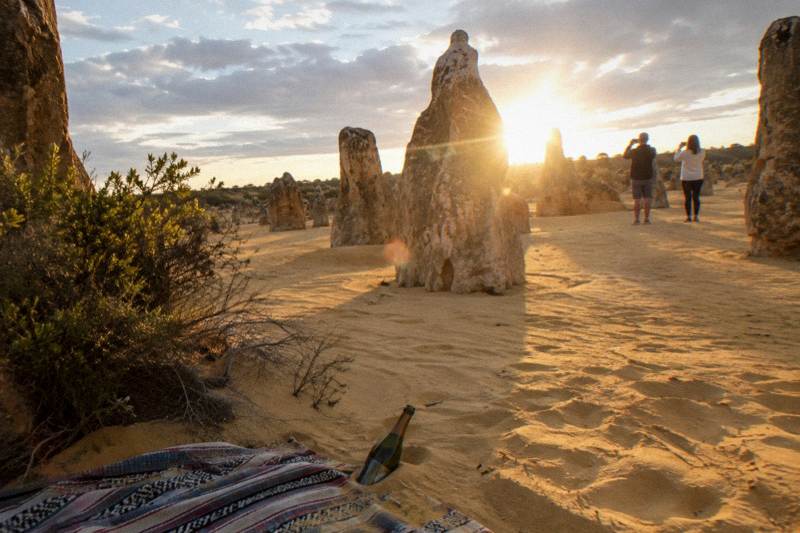
Photographing The Pinnacles: Light, Timing And Gear
The Pinnacles are one of the most photographed landscapes in WA, and the difference between a flat snapshot and a striking frame usually comes down to light and timing rather than equipment.
Short answer
The Pinnacles are thousands of limestone pillars up to about 3.5 m tall, about 200 km north of Perth, best photographed in the low light around sunset or early morning. A 4.5 km one-way drive trail and a 1.5 km walk trail put you among the pillars, and sunset tours run until after dark so night photography is possible.
If photographing the pillars is the point of the trip, a guided departure solves the two hardest problems at once: you arrive without a two hour drive behind you, and you are still there when the light turns. The Autopia sunset stargazing dinner tour is built around that window, and the guide works through the light, the shapes and the timing questions photographers ask most.
| Fact | Detail |
|---|---|
| Pillar height | Up to about 3.5 m tall |
| Pillar material | Limestone formed from ancient sea shells |
| Drive trail | About 4.5 km one way, unsealed, no trailers or caravans |
| Walk trail | 1.5 km, starting with a 300 m accessible path |
| Visitor centre hours | 9:30 am to 4:30 pm daily, closed Christmas Day |
| Distance from Perth | About 200 km, roughly 2 hours to Cervantes |
| Climb rule | Never climb on the pinnacles |
Why The Pinnacles Desert Rewards A Camera
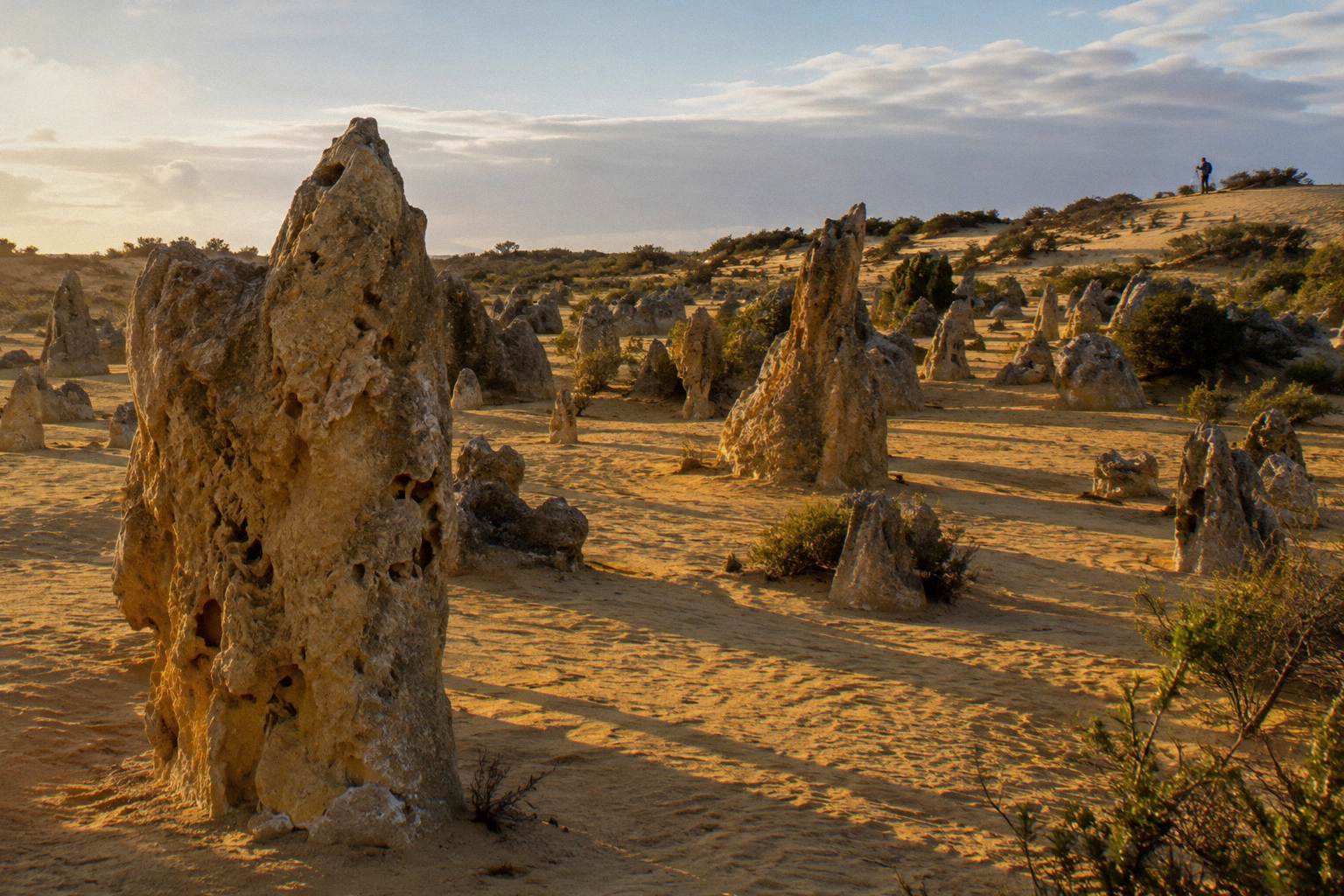
This is a landscape that changes character completely with the angle of the sun, which is why timing matters more here than almost anywhere else within reach of Perth. Thousands of limestone pillars rise straight out of yellow sand, and because they stand alone rather than in a forest or cliff face, every one of them catches raking light on its own edge. Midday sun flattens them; low sun turns each column into a hard shadow and a bright face.
The pillars vary enormously in form. Some are jagged, sharp-edged columns, others resemble tombstones, and many show cross-bedding, the layered lines that record how the dunes the limestone formed from were laid down by wind. Some are mushroom shaped, because a harder calcrete cap weathers more slowly than the limestone below it, leaving a wide head on a narrower stem. For a photographer that variety is the gift: within a short walk you can frame a sharp spire, a rounded tombstone and a mushroom shape against the same sky.
The colours also do a lot of work. The sand is a deep yellow, the pillars range from pale bone to rust-stained orange, and the low western light of the Coral Coast in the afternoon warms all of it. None of this needs a long lens or a tripod to capture. What it needs is being there when the sun is low, and knowing which shapes to look for, which is what the rest of the guide covers.
What The Pillars Actually Look Like Up Close
There are four broad pillar shapes to look for, and each one photographs differently: jagged columns with sharp edges, tombstone-like slabs, cross-bedded pillars with visible wind-laid layering, and mushroom shapes whose calcrete caps have protected a narrower stem below. Recognising them quickly lets you compose instead of hunting, especially in the short window when the light is at its best.
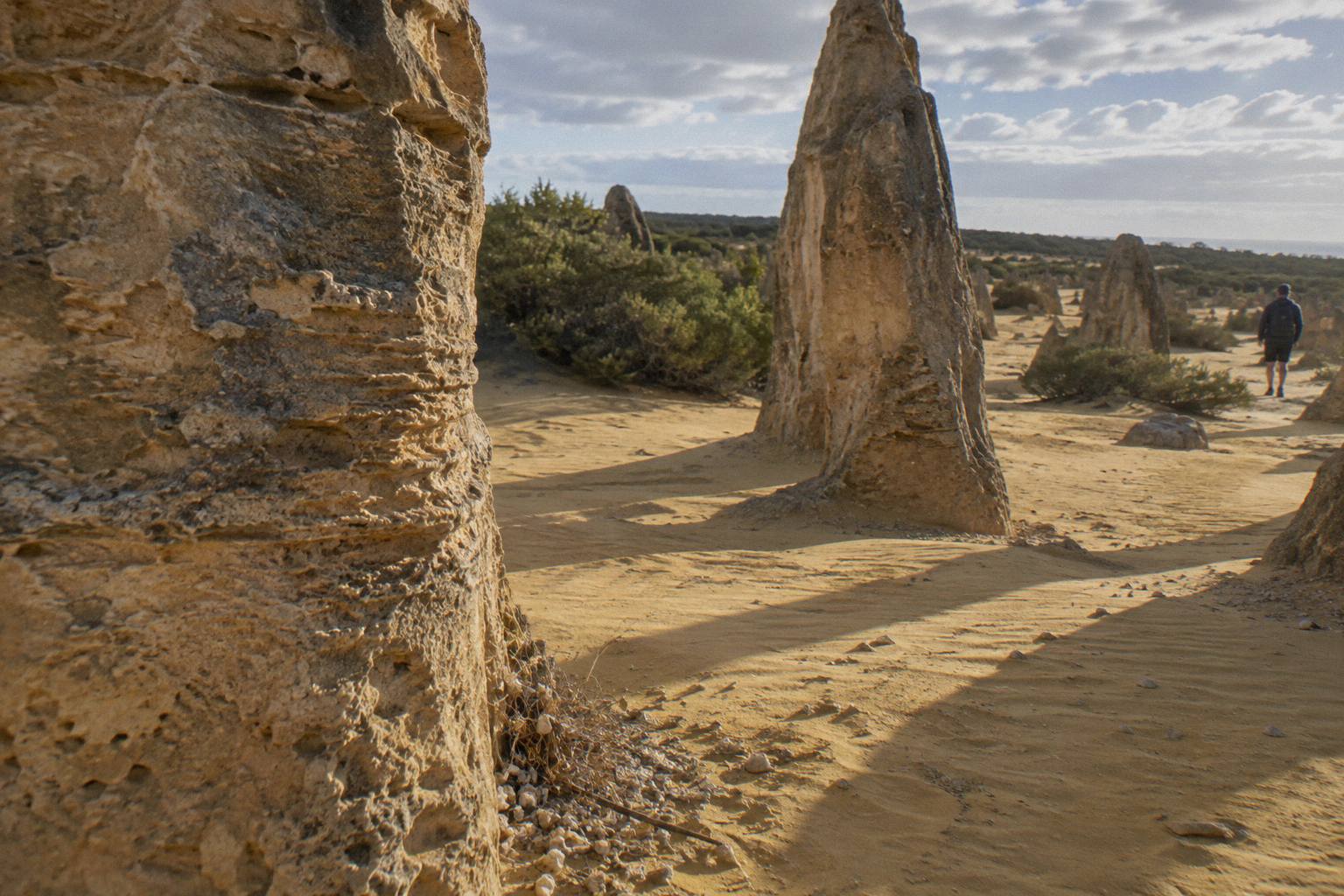
The detail comes from the DBCA lookout page and the descriptions below are drawn from it, so they hold up when you are standing among the pillars.
| Shape | What To Look For | Why It Photographs Well |
|---|---|---|
| Jagged column | Sharp edges, angular silhouette | Strong graphic outline against open sky |
| Tombstone | Rounded, slab-like form | Simple shape that reads clearly at distance |
| Cross-bedded pillar | Visible angled layering in the stone | Adds texture when sidelight rakes across it |
| Mushroom shape | Wide calcrete cap on a narrower stem | Unusual profile, works as a single-subject frame |
Two practical notes shape how you shoot them. First, never climb on the pinnacles; DBCA is explicit about this, and a low camera angle from the sand achieves the dramatic perspective anyway. Second, because the pillars stand in loose sand, a wide lens held low will pick up foreground texture, which gives flat desert scenes depth. A reader planning a fuller read on what the day looks like end to end will find the drive, the stops and the timing set out in order.
The cross-bedding deserves a slow look. Those internal layers indicate the dunes the limestone formed from were laid down by wind, and when low sun strikes a broken pillar face at an angle, the banding shows as alternating light and dark lines. It is the kind of detail that separates a considered frame from a wide grab shot, and it is everywhere once you start noticing it.
Sunset Versus Daytime: How The Light Differs
A daytime visit gives even, workable light and easy walking; a sunset visit gives directional warmth, long shadows and a sky that changes minute to minute, then finishes in darkness with a star field overhead. Photographically the sunset window is stronger for shapes and drama, while daytime suits texture, pattern and a relaxed circuit of the walk trail. The trade is simple: sunset means timing everything backwards from the light.
| Factor | Daytime Visit | Sunset Visit |
|---|---|---|
| Light on pillars | Even, cool, low contrast | Warm, directional, long shadows |
| Sky | Consistent blue | Graded colour, changing by the minute |
| Walking comfort | Hotter in summer months | Cooling through the visit |
| After the light fades | Departure in daylight | Darkness, stars, headlights on sand |
| Best subjects | Texture, cross-bedding, patterns | Silhouettes, rim-lit columns, sky |
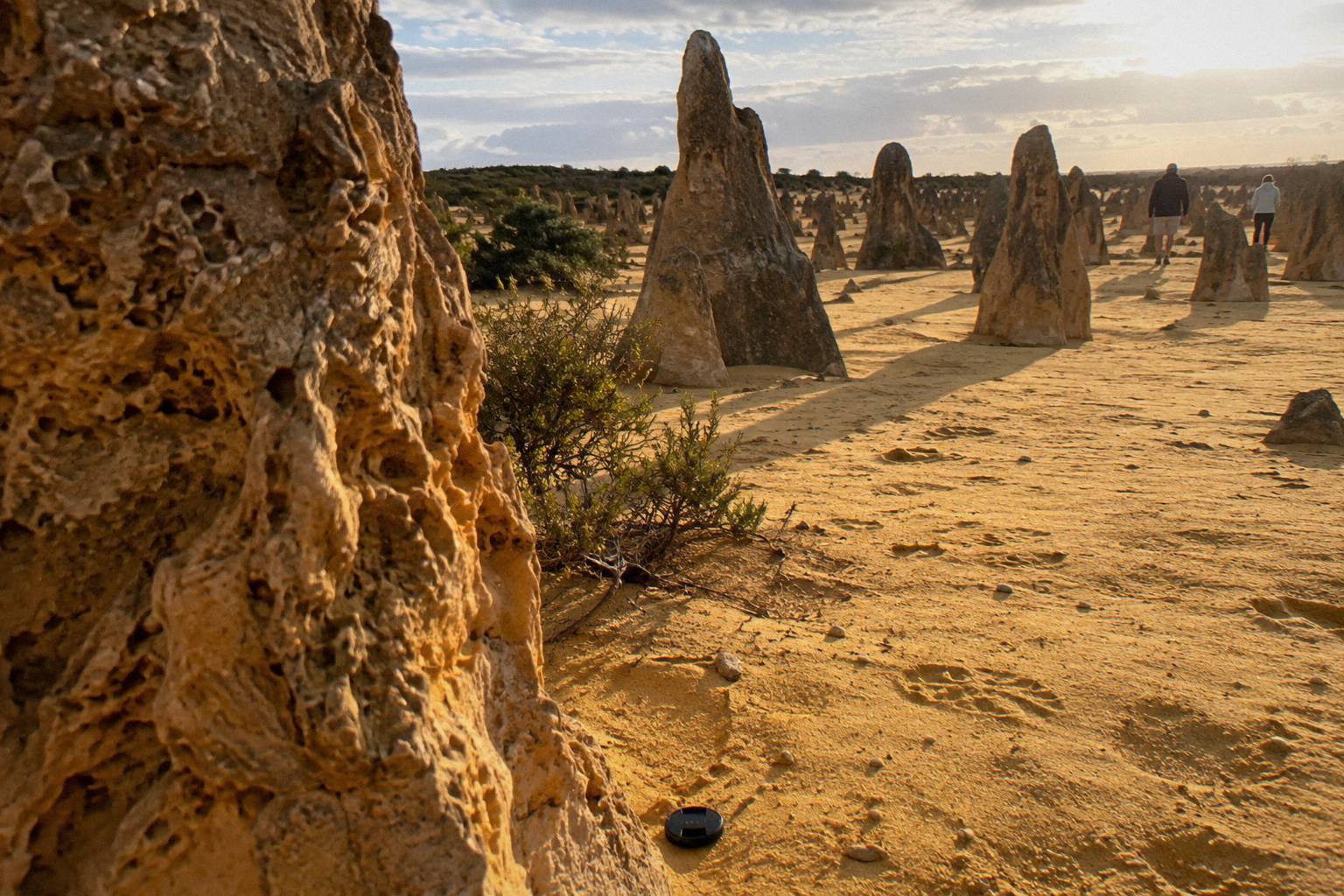
The sunset window itself is generous but finite. Perth's sunset range runs from about 5:26 pm at its earliest in June to about 7:27 pm at its latest in early January, and the Pinnacles sit roughly on the same longitude, so the usable golden window before darkness is on the order of an hour, with the best raking light in the final twenty minutes or so. Photographers who want the full arc, warm light into blue hour into stars, should plan to still be among the pillars after the sun drops below the horizon.
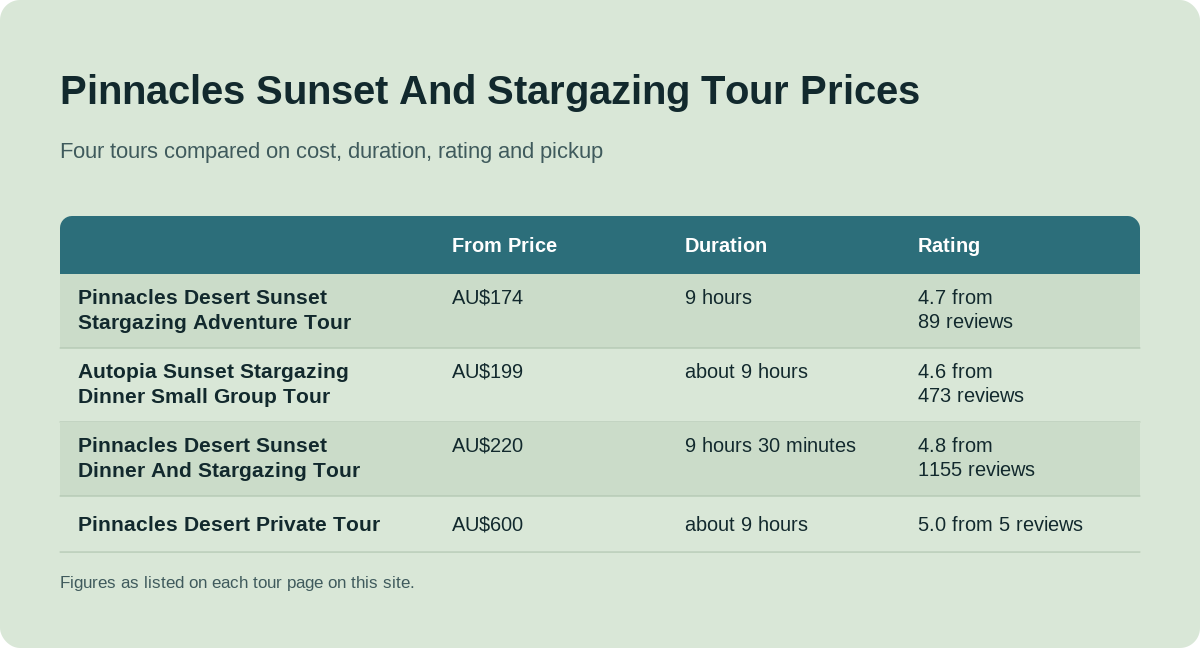
That is exactly what a sunset tour buys you. The "Pinnacles Sunset Stargazing Dinner Experience Small Group Tour" from Autopia Tours runs about 9 hours, is rated 4.6 from 473 reviews, and costs from AU$199 per person, with free cancellation up to 24 hours before start. Its pickup is from selected Perth inner-city pick-up and drop-off points, and park entry and a meal are included. See dates on the booking calendar early, because sunset departures are the ones photographers want and they fill first.
The comparison worth making if light is the priority is against doing it yourself in a rental. A self-driven sunset visit means driving back to Perth in the dark on country roads after a long day, while a guided departure puts a driver on that leg. The trade-off is control: on your own you can stay at one pillar for the entire golden hour, and no schedule moves you along. The deeper sunset and stargazing tours compared guide works through that choice product by product.
For photographers whose priority is a specific frame rather than a general golden hour, a private tour solves the scheduling problem outright. The "Pinnacles Desert Private Tour" from Libertino Travel runs about 9 hours from AU$600 per person, includes park entry and sandboarding, and picks up and drops off from your accommodation; it has 5 reviews.
Timing A Sunset Departure For Photography
Work backwards from the light, not from the pickup. If the golden window is the final hour before sunset, you want to be walking among the pillars, camera ready, an hour before that, which means arriving around two hours before sunset. Sunset departures from Perth are built around this arithmetic, and their itineraries typically reach the desert with time to walk before the light peaks, then serve dinner and stay on for stars.
The months matter as much as the hour. The Bureau of Meteorology Jurien Bay table, the nearest full climate record to the Pinnacles, shows mean monthly rainfall peaking in June at 106.6 mm and July at 111.1 mm, and falling to a driest December at 6.0 mm. Cloud is the enemy of both sunset colour and star photography, so the drier months of late spring and summer carry less weather risk, while the cooler months trade some cloud risk for earlier sunsets that suit families and long exposures.
Wildflowers add a foreground option in late winter and spring. DBCA says the park's vegetation bursts into flower from August to October, and Coral Coast tourism puts the season July to October, peaking August to September, though amounts always vary with rainfall. A low bed of white and yellow flowers at the base of a pillar gives sunset frames a foreground layer that bare sand cannot, and it costs nothing but arriving in the right months.
The moon is the other clock. For star photography, the days around a new moon give the darkest sky, and a bright moon washes out the fainter stars, so check the lunar calendar alongside the weather forecast before locking a date. The dedicated guide to stargazing months and moon phases covers that planning in full.
Routes And Angles: The Drive Trail And The Walk Trail
There are two ways to get among the pillars, and they suit different shooting styles. The drive trail is about 4.5 km one way, unsealed, with parking bays that let you hop out and work a cluster of pillars, then move on; the Desert View Walk Trail is 1.5 km, beginning with a 300 m Class 1 accessible path to a viewing platform before continuing as a 1.2 km Class 3 sandy trail through the pillars themselves.
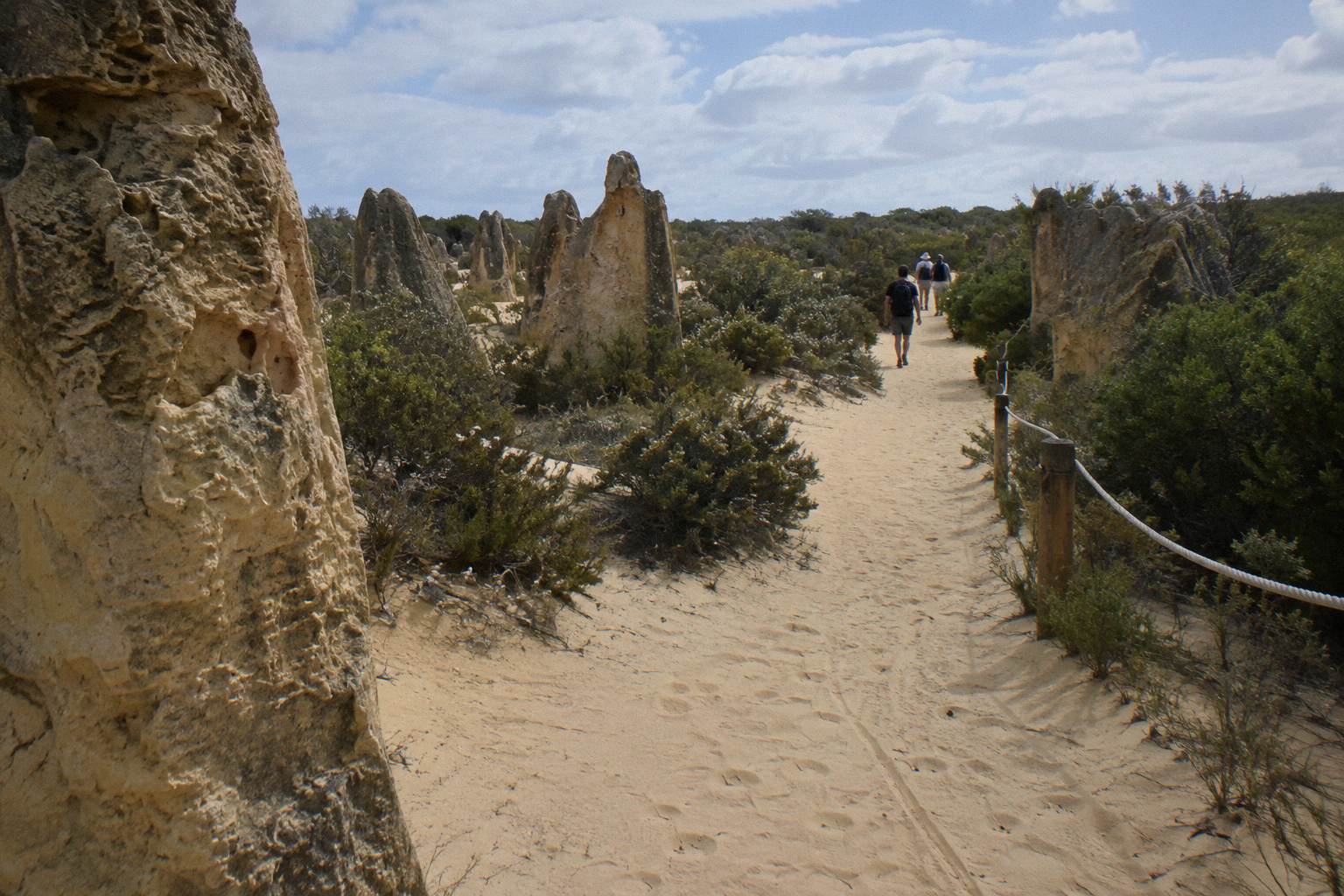
The walk trail is where the best close compositions live, because the sandy section threads between the pillars rather than past them. Sand underfoot means steady footing is not guaranteed, so a camera strap earns its place, and the low angle from the track puts pillars against sky with almost no horizon clutter. The viewing platform at the start also gives a clean elevated overview, useful for a first orientation shot before you commit to the sand. The wider set of guides lives on Pinnacles Desert Tours.
The drive trail has its own logic for photographers. Because vehicles longer than 7 m, caravans and trailers are not permitted on the loop, the traffic is light, and the parking bays are positioned at the denser stands of pillars. Working the loop by car in the last hour before sunset lets you chase the light direction, parking where the sun rakes across a formation rather than behind it. The DBCA Discovery Centre page describes both trails and the centre itself, which is open 9:30 am to 4:30 pm daily and closed Christmas Day.
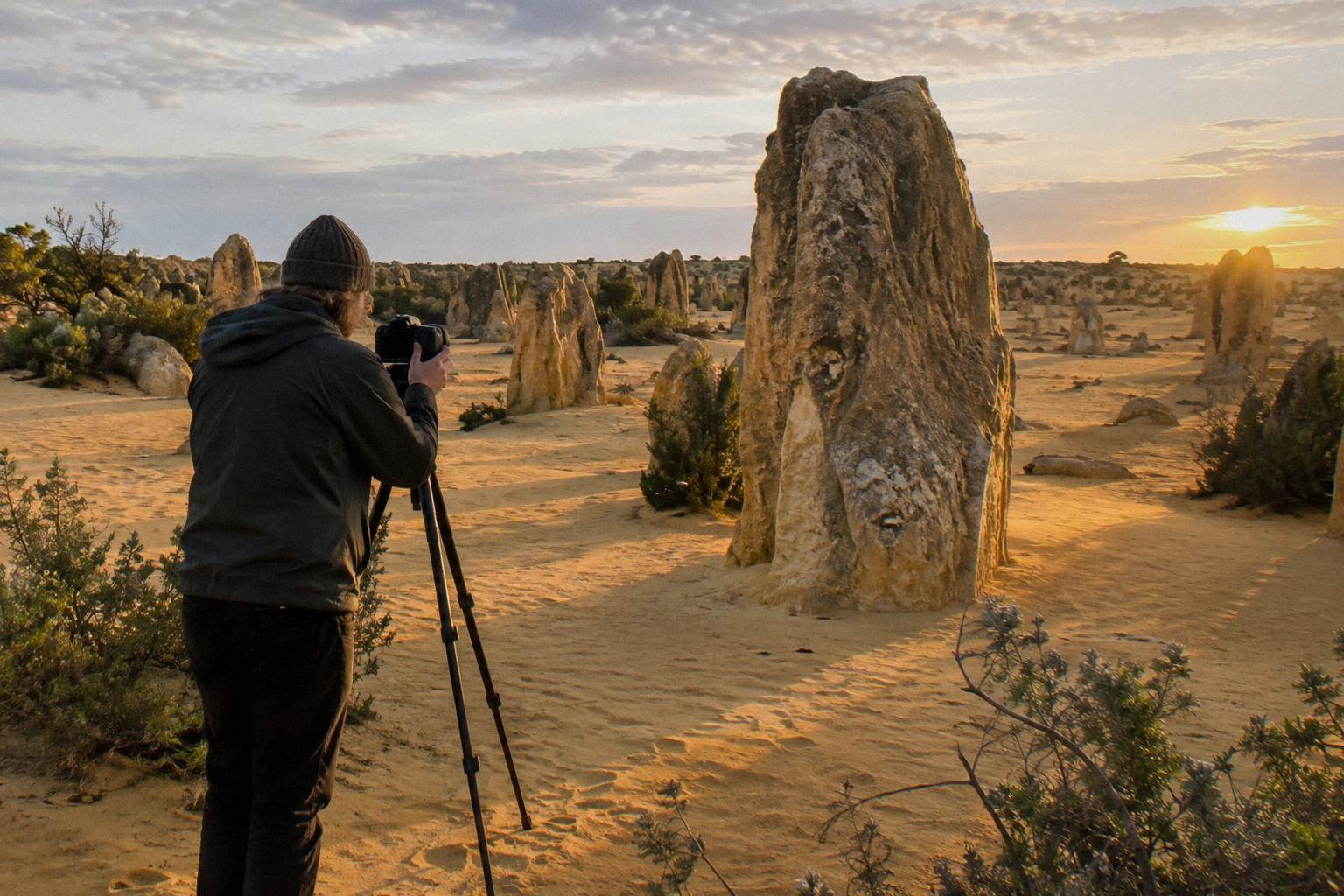
One framing decision deserves thought before you arrive: west is the sunset direction, and Hangover Bay and the ocean lie that way too, so pillars shot facing west in the evening will carry the warm sky behind them, while east-facing frames give you lit stone against a darker sky. Walking the trail in a loop lets you take both. Photographers wanting more on the surrounding coast can read the Cervantes, Lake Thetis and Hangover Bay guide for the nearby stops.
Gear That Fits A Day Trip
Keep the kit light and sand-aware: a single wide-to-mid zoom covers the Pinnacles, a tripod matters only if you are staying past dark, and protection from sand and sun matters more than any extra lens. The terrain is a short sandy walk plus a slow drive, so anything heavy works against you, and the desert environment is harder on equipment than the walking is.
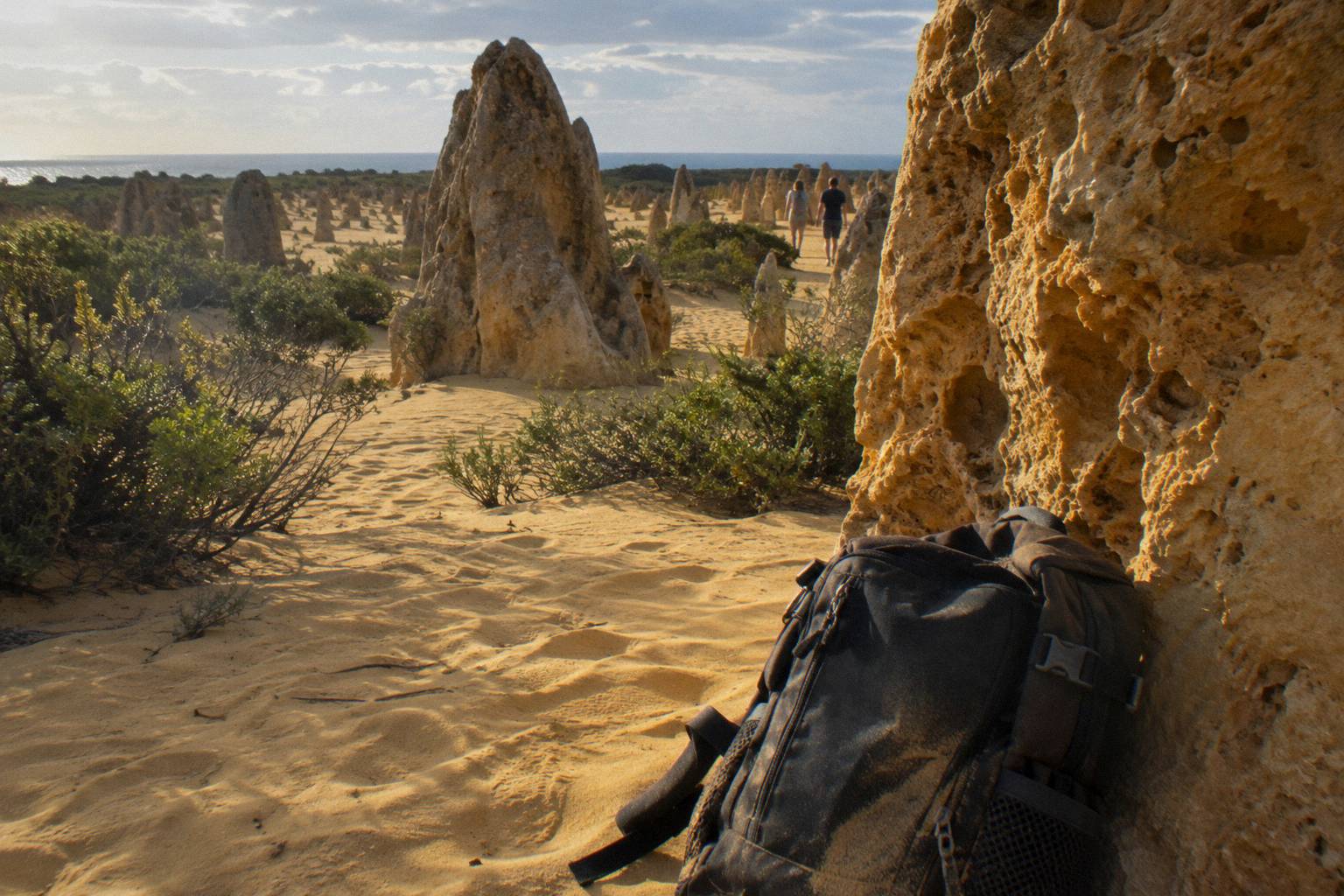
A practical list: a zoom covering roughly wide to short telephoto, spare batteries since cold nights and long exposures drain them, a lens cloth for sand and salt haze, closed shoes for the sandy trail, and water. If stars are on the plan, a tripod and a remote or timer release are what make the difference, because handheld night frames of a dark desert will not hold sharpness. A headlamp with a red mode helps you walk out without killing your night vision or everyone else's.
Sand is the one environmental hazard worth respecting. Fine yellow sand gets into zoom barrels and tripod feet, so change lenses as little as possible, and keep the bag zipped when it is on the ground. Summer visits bring heat and the possibility of extreme fire danger, and the park's own guidance recommends carrying a personal location beacon in that season. The what to wear and bring guide extends this for sunset departures specifically.
Photographing After Dark: Stars And The Desert At Night
Once the sun is fully down, the Pinnacles become a night-sky location, and the pillars work as silhouettes and foreground shapes against the stars rather than as subjects in their own light. What you can capture depends entirely on cloud, moon and how long you stay, so no specific sky can be promised, but a departure that remains in the park after dark is the practical requirement, since a self-drive day visit leaves before this window opens.
Perth's glow is distant from the desert, and astronomy club guides in WA rate the Pinnacles among the darker locations within reach of the city, with the Milky Way at its best near a new moon and the clearest skies through the cooler months. Exposure settings are the standard night set: a wide aperture, the shortest shutter speed that keeps stars as points rather than trails on your focal length, and high ISO, then lift shadows in processing. A pillar framed against the Milky Way band is the classic composition, and the mushroom shapes make strong anchors for it.
Tours that stay for the stars remove the hardest part of night photography here: driving out. The "Pinnacles Desert Sunset Dinner and Stargazing Tour" from Lumineer Adventure Tours runs 9 hours 30 minutes, is rated 4.8 from 1,155 reviews, and costs from AU$220 per person with free cancellation up to 24 hours before start; park entry, CBD hotel pickup, sandboarding, a meal and stargazing are included. Check availability on its page if the after-dark window is the one you want.
For photographers who want the golden hour but not a full night, the 9-hour "Pinnacles Desert Sunset Stargazing Adventure Tour" from Wildlife Tours Australia is rated 4.7 from 89 reviews and costs from AU$174 per person, with pickup from selected inner-city points and park entry, a meal and stargazing included. See dates on its page to compare against the longer departures.
The night adds a simpler pleasure too. Standing in a quiet desert with the sky fully dark is something a daytime visit cannot offer at all, and even photographers who never mount the tripod tend to remember that half hour. Cloud can cover the stars on any given night, and the guide to what happens when cloud covers the stars sets out how departures handle it.
What Trips People Up Before You Book
The recurring mistakes are all timing mistakes: arriving at midday and wondering why the pillars look flat, booking a day-only departure and realising too late that the best light comes after it leaves, or planning a self-drive sunset visit without accounting for the dark drive back. Each one is avoidable with a single decision made early, which is choosing the departure that matches the light you want.
The first and most common is underestimating the midday sun. The pillars are pale limestone on yellow sand, and overhead light removes the shadows that give them form, so a visitor who arrives at noon often leaves disappointed by photographs that look washed out even though the landscape itself was spectacular. The fix is structural: plan the visit around early morning or late afternoon, full stop.
The second is assuming any sunset tour equals a photography window. Some departures spend the golden hour at dinner or at another stop and reach the pillars at dusk, which suits a holiday but frustrates a photographer. Read the itinerary of the specific product and see where the desert visit sits relative to the evening. The third is forgetting the season: a June sunset comes early and a January one late, so the same tour shifts its rhythm by roughly two hours across the year, and the booking calendar shows the start time for your date.
The fourth is the return leg. A self-drive sunset plan ends with roughly two hours of night driving on unfamiliar roads, and mobile coverage in parts of the park is patchy or absent; the park's own visitor guidance recommends the Emergency+ app because without coverage the standard emergency number will not connect, though the app can still supply your GPS location. A guided departure hands that leg to a professional driver, which is why so many photographers choose one even when they would normally drive themselves. Whether a booking is needed ahead of time is covered in the do I need to book in advance post.
Common Questions About Photographing The Pinnacles
What Time Of Day Is Best For Photographing The Pinnacles?
The final hour before sunset and the first hour after sunrise, when low directional light gives each pillar a lit face and a long shadow. Sunset is the more practical of the two for most visitors, and guided sunset departures are timed around that window.
How Tall Are The Pinnacles Pillars?
The pillars reach up to about 3.5 m tall, rising from yellow sand. Shapes range from jagged sharp-edged columns to tombstone-like slabs and mushroom forms with harder calcrete caps.
Can You Photograph The Stars At The Pinnacles?
Yes, on a clear night and best near a new moon. Perth's light glow is distant from the park, and astronomy club guides rate it among the darker locations within reach of the city. You need to still be in the park after dark, which a sunset and stargazing departure arranges.
Do I Need A Tripod For The Pinnacles?
Only if you are staying past dark. Daytime and sunset frames are easily handheld, while night sky photography needs a tripod and a remote or timer release to keep stars sharp.
Can You Walk Among The Pillars Or Only Drive?
Both. A 4.5 km one-way drive trail with parking bays loops through the desert, and the 1.5 km Desert View Walk Trail starts with a 300 m accessible path then continues as a 1.2 km sandy trail among the pillars themselves.
Which Months Give The Best Conditions For Photos?
Drier months carry less cloud risk: Jurien Bay rainfall bottoms out at 6.0 mm in December against 111.1 mm in July. Wildflowers add foreground interest from August to October, peaking August to September, though always rainfall dependent.