Pinnacles At Night: What You Can See And How To Get There
The Pinnacles Desert changes character after the sun drops: the limestone pillars keep their shapes, the temperature falls, and the sky over Nambung National Park becomes the main event. Here is what a night visit actually involves, what the sky depends on, and the ways to get there from Perth.
Short answer
At night the Pinnacles Desert offers dark skies well away from Perth's glow, with thousands of limestone pillars up to about 3.5 m tall silhouetted against the horizon. Guided sunset and stargazing tours from Perth run from AU$174 per person and last about 9 hours. What you see overhead depends on cloud, moon and season, so no tour can promise stars.
Start here: the sunset and stargazing category from Perth is how most night visits run, because those tours bundle the drive, the park stop and the after-dark hours into one booked departure.
| Fact | Detail |
|---|---|
| Location | Nambung National Park, about 200 km north of Perth |
| Gateway town | Cervantes, about 17 to 19 km from the Pinnacles, roughly 15 to 20 minutes |
| The pillars | Thousands of limestone pillars, some up to about 3.5 m tall |
| The drive loop | About 4.5 km one way, unsealed, no vehicles over 7 m, caravans or trailers |
| Park entry 2026 | AU$17 per standard vehicle, concession AU$10, or a valid park pass |
| Night sky | Depends on cloud, moon phase and season; no stars are promised |
| Nearest climate record | Jurien Bay Bureau of Meteorology station, wettest June and July, driest December |
| Visitor centre | Pinnacles Desert Discovery, open 9:30 am to 4:30 pm daily, closed Christmas Day |
What Changes At The Pinnacles Once The Sun Goes Down
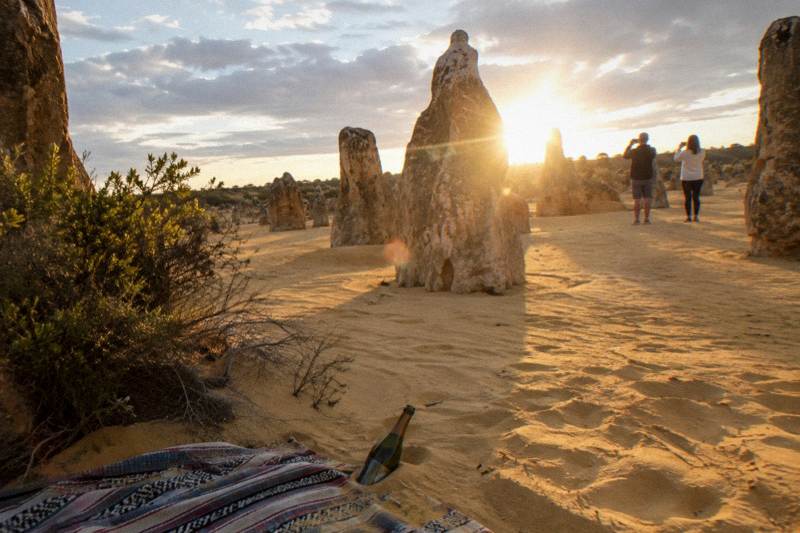
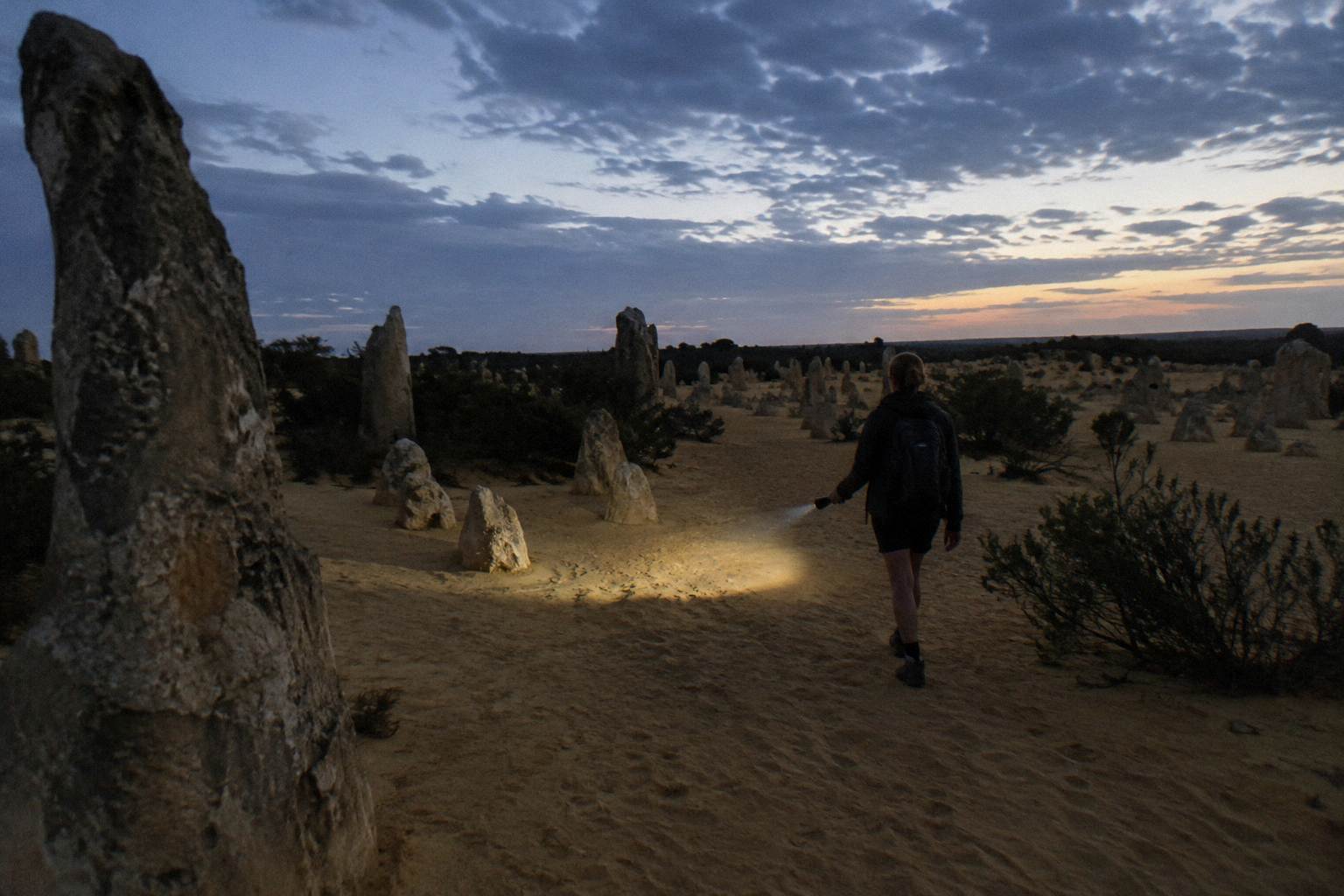
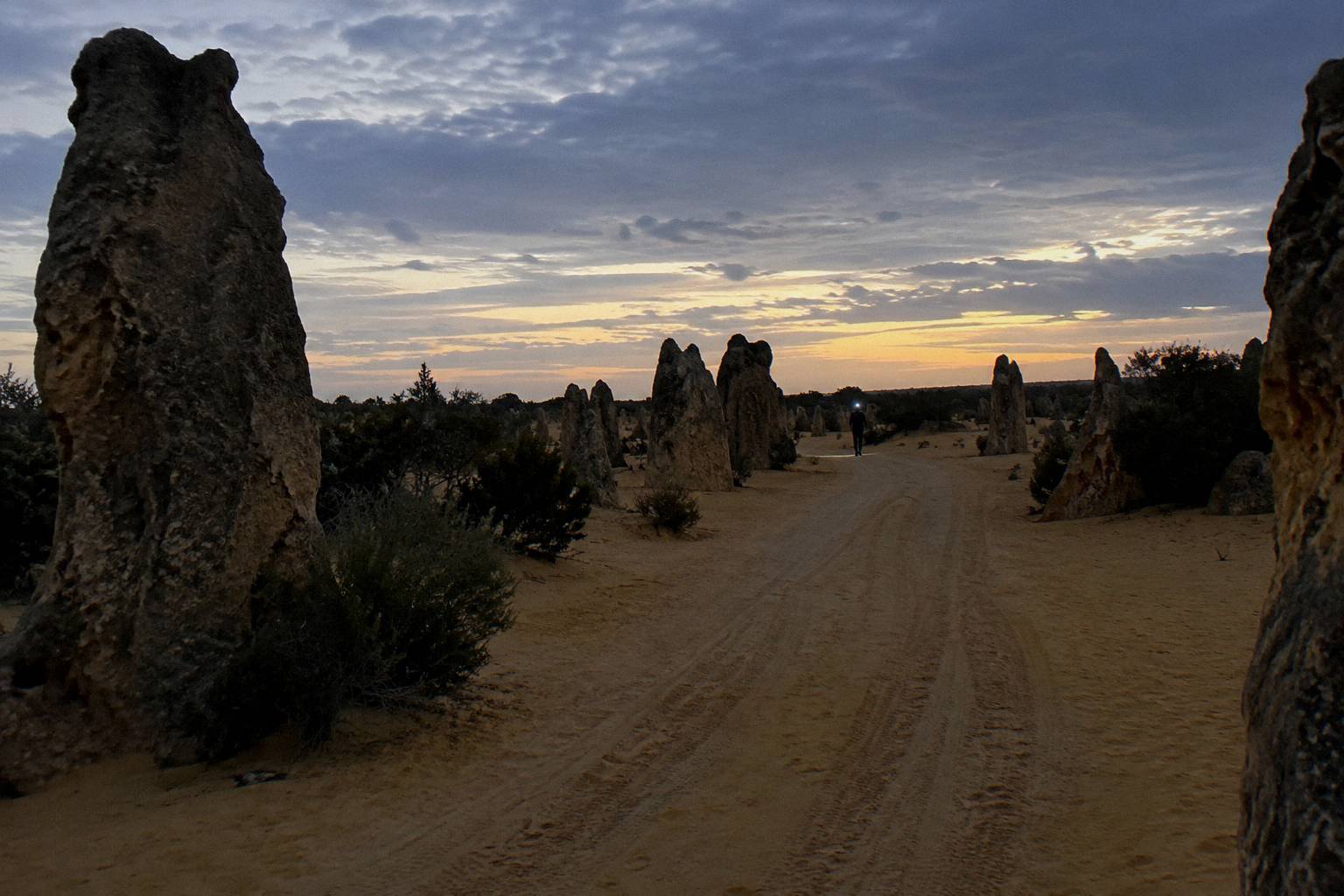
After dark the Pinnacles Desert keeps its pillars and loses its crowds, and the sky becomes the reason most people stay. The limestone columns that stand in yellow sand by day, some reaching up to about 3.5 m, turn into silhouettes against the horizon, and the afternoon heat drops away. Perth's glow is distant from Nambung National Park, though exactly what you see overhead depends on cloud, moon and season.
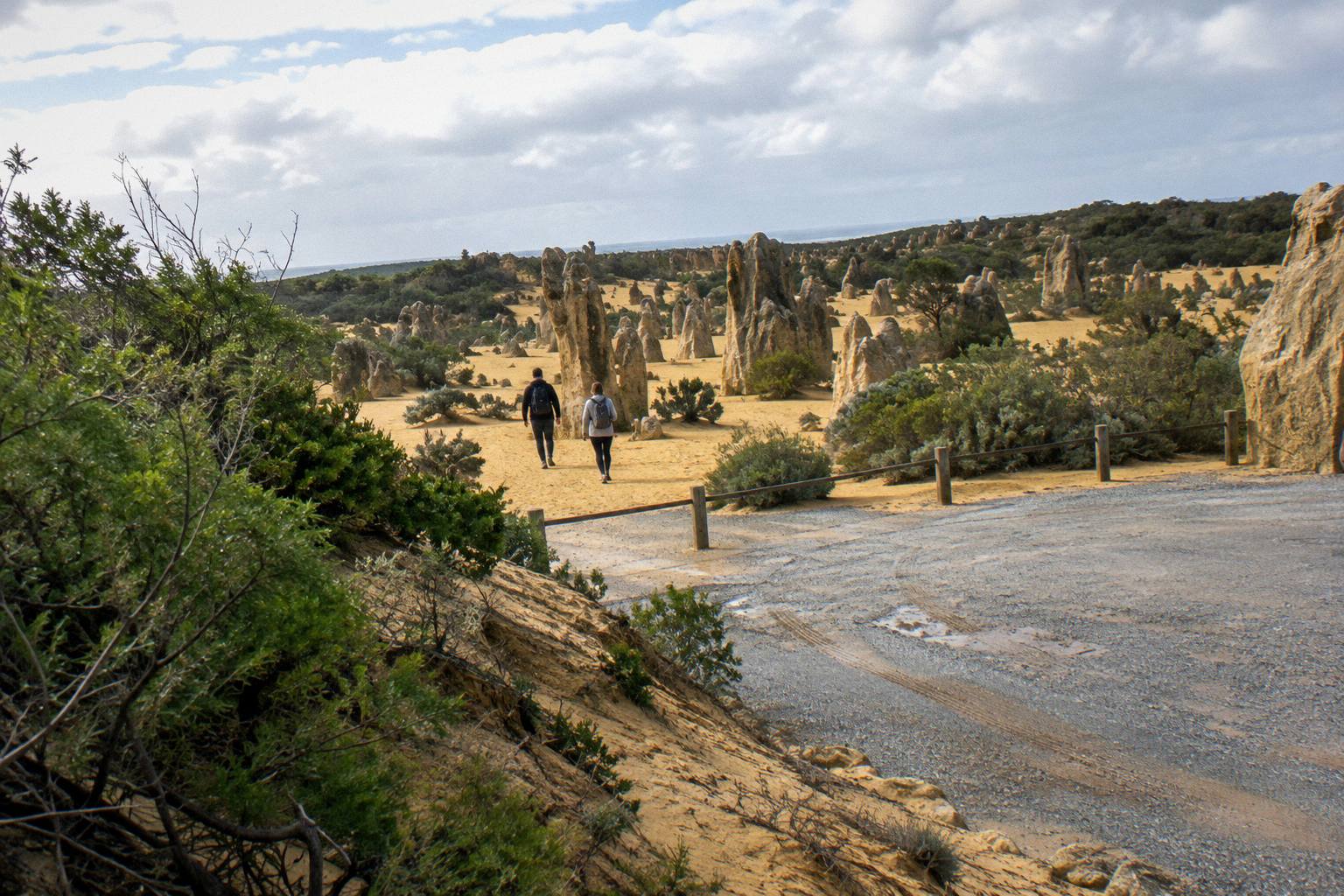
By day the Pinnacles are a landscape of sharp-edged columns and tombstone shapes, some mushroom capped, formed from ancient sea shells broken into lime-rich sand, carried inland by wind and cemented into limestone by winter rain. The pillars were exposed when wind removed the covering sand, and DBCA, the parks authority, is blunt about one rule on its Pinnacles Desert lookout page: never climb on the pinnacles. That holds at night too, when the pillars are harder to judge by eye.
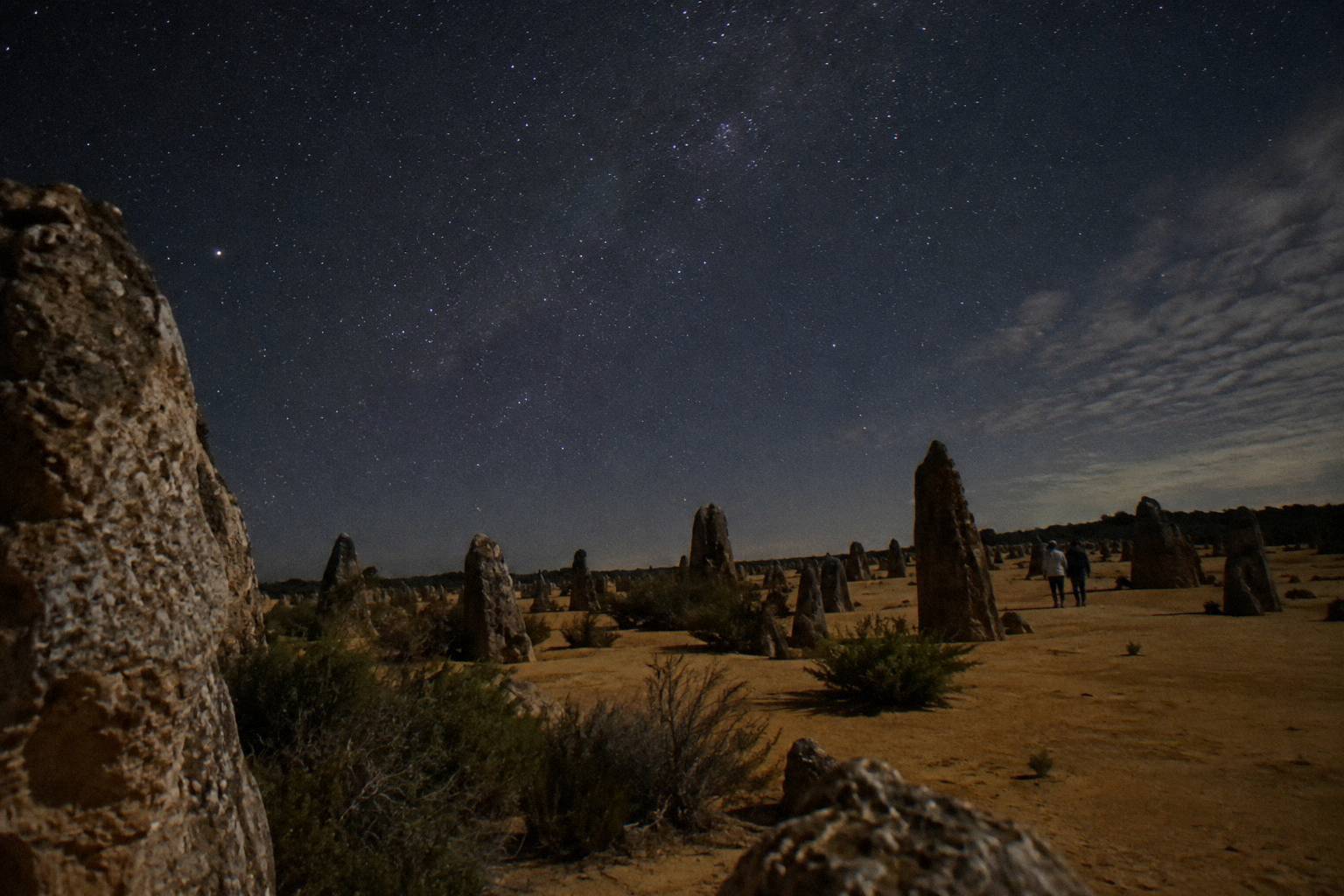
What the night adds is darkness and a long horizon. The park is roughly 200 km north of Perth, far enough that the city's light sits low and distant rather than overhead. Astronomy club and retailer guides rate the Pinnacles very dark indeed, but those are club sources, not a government measurement, so treat darkness as a strong likelihood rather than a certified figure. The realistic framing is simpler: this is one of the more accessible genuinely dark locations within a couple of hours of a capital city, and a night visit gives it to you without a camping trip, because there is no camping in Nambung National Park.
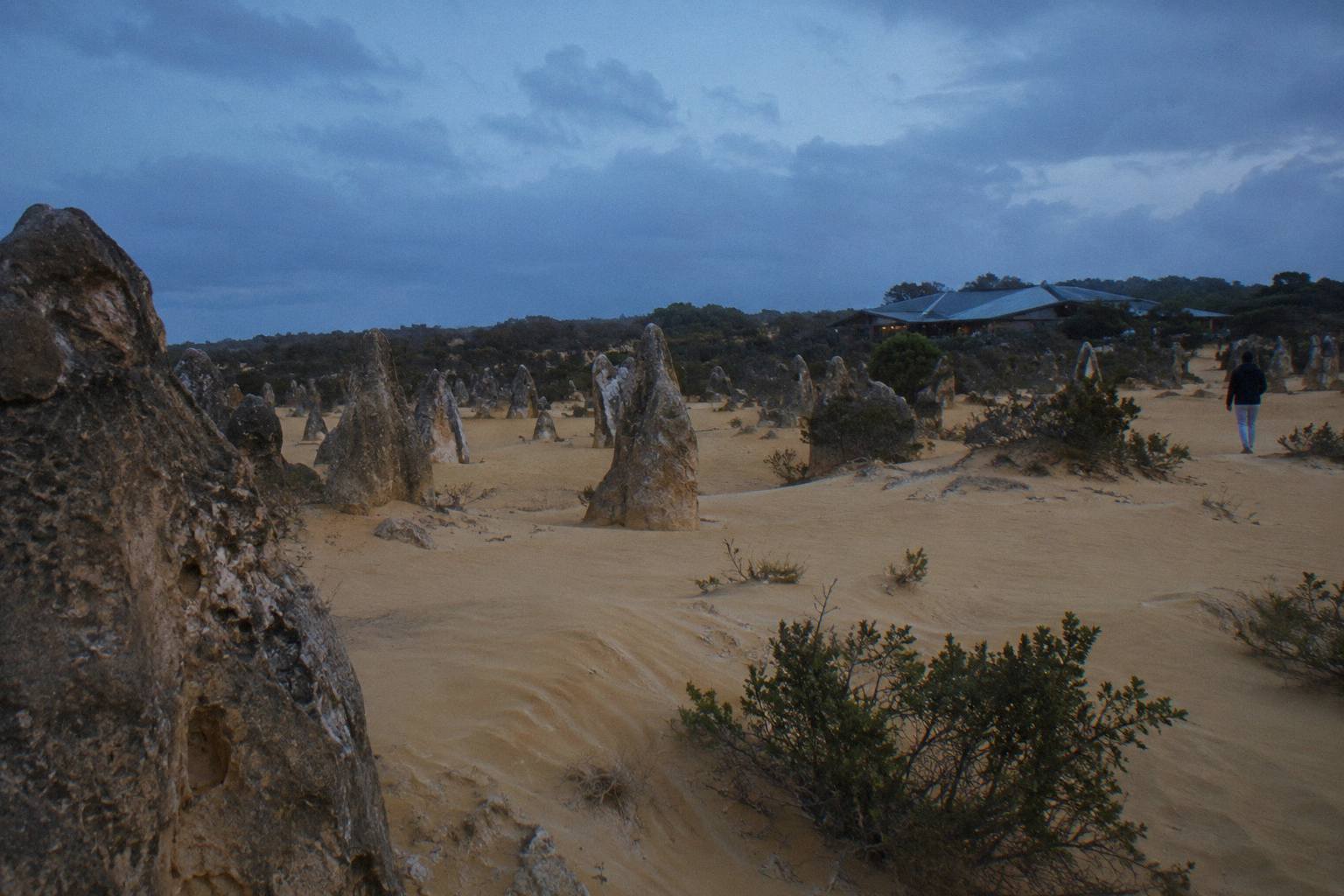
The practical shift is logistical. The Pinnacles Desert Discovery centre, the visitor facility with displays and a shop, closes at 4:30 pm, so a night visit is about the desert itself, not the exhibits. Toilets sit at the discovery centre. Everything after closing time is outdoor, unlit except for whatever you carry, and shaped by the weather the Bureau of Meteorology records for the coast: hot dry summers from December to March, and the wettest months of June and July.
Which Night Tours Run From Perth
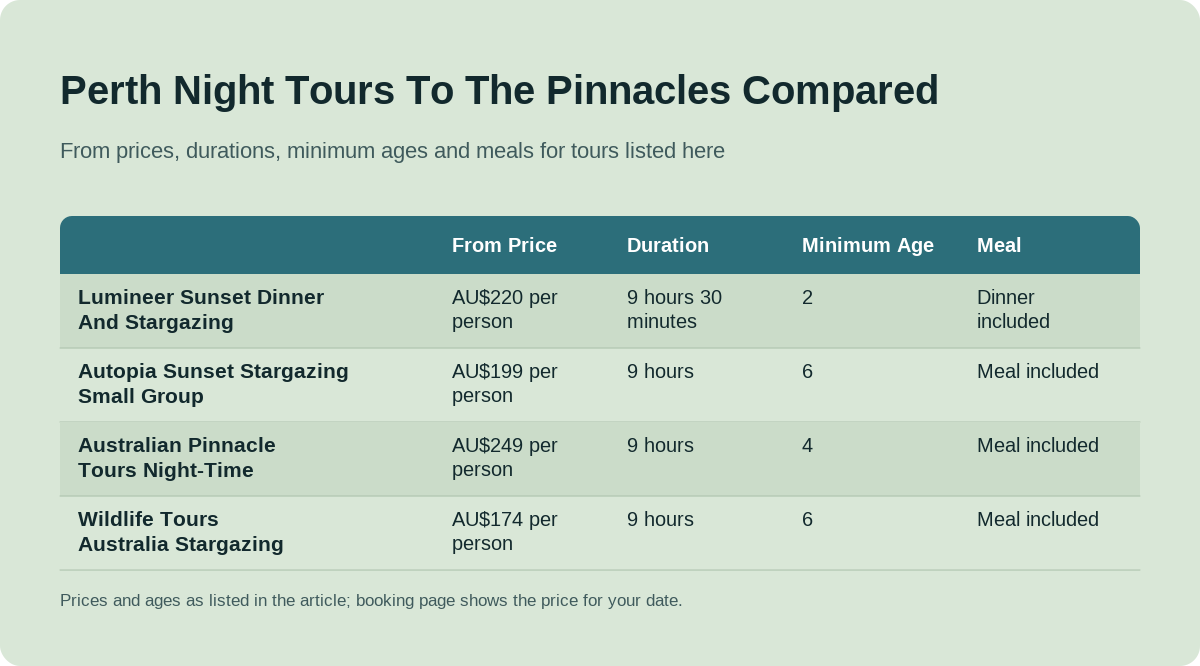
Guided night trips are the practical way to see the Pinnacles after dark, because every one of them handles the roughly 200 km drive each way and returns you to the city late. The format is a shared coach or minibus departure, a sunset stop among the pillars, and an after-dark component that may include dinner, sandboarding or guided stargazing. Prices run from AU$174 to AU$249 per person, with durations around 9 to 9 hours 30 minutes.
The category exists for one reason: a night visit under your own steam means a long return drive in the dark, and tours absorb that. Each departure is a separate bookable product with its own inclusions, so the comparison below is per product, not per operator. All amounts are Australian dollars, prices vary by date, and the booking page shows the price for your date. Every product listed here offers free cancellation up to 24 hours before start.
| Tour | From price | Duration | Minimum age | Meal |
|---|---|---|---|---|
| Pinnacles Desert Sunset Dinner and Stargazing Tour (Lumineer) | AU$220 per person | 9 hours 30 minutes | 2 | Dinner included |
| Pinnacles Sunset Stargazing Dinner Experience Small Group Tour (Autopia) | AU$199 per person | 9 hours | 6 | Meal included |
| Pinnacle Desert Sunset and Night-time Stargazing Tour from Perth (Australian Pinnacle Tours) | AU$249 per person | 9 hours | 4 | Meal included |
| Pinnacles Desert Sunset Stargazing Adventure Tour (Wildlife Tours Australia) | AU$174 per person | 9 hours | 6 | Meal included |
The differences that matter at decision time are age minimums and inclusions. The Lumineer sunset dinner stargazing tour takes children from age 2 and names park entry, Perth CBD pickup, sandboarding, a meal and stargazing among its inclusions, rated 4.8 from 1,155 reviews, the largest review pool in the category. The Wildlife Tours Australia adventure is the entry price at from AU$174 per person, rated 4.7 from 89 reviews, with park entry, CBD pickup, a meal and stargazing included. Autopia's small-group version sits between at from AU$199 per person, 4.6 from 473 reviews, minimum age 6.
The Night-Time Stargazing tour from Australian Pinnacle Tours is the premium shared option at from AU$249 per person, 4.4 from 131 reviews, with hotel pickup and drop-off and a meal included, minimum age 4. Two further products are worth knowing about even though they have only a handful of reviews: Tour2Holiday runs a koalas, sunset and stargazing trip with homemade dinner from AU$209 per person, minimum age 3, and Lumineer operates a High Tea and Dark Sky Astronomy departure with park entry, CBD pickup and a meal included, whose price and duration sit on the booking page. For a sense of how these stack up in detail, the sunset and stargazing comparison guide works through inclusions and formats product by product.
For a fuller picture of the sky itself, including moon phase planning, the Pinnacles stargazing months and moon phases guide is the companion piece to this one.
What The Night Sky Actually Depends On
No tour can promise stars, and any sound planning starts with three variables: cloud cover, moon phase and season. Cloud decides whether there is a sky at all, the moon decides how dark it gets, because a bright moon washes out faint objects, and the season shapes both rainfall and how late darkness falls. The Bureau of Meteorology's Jurien Bay record shows June and July wettest at 106.6 and 111.1 mm, and December driest at 6.0 mm.
Cloud is the single decider. A night can be perfectly dark and perfectly overcast, and operators run their departures regardless, because the sunset, the pillars and the dinner are still there. What happens when the sky clouds over is covered in what happens if cloud covers the stars on a stargazing tour, but the short version is that the trip runs and the after-dark segment becomes a night-time landscape experience rather than an astronomy one.
| Variable | What it controls | How to plan around it |
|---|---|---|
| Cloud | Whether the sky is visible at all | Wettest months June and July at 106.6 and 111.1 mm; December driest at 6.0 mm |
| Moon phase | How dark the sky gets; a bright moon washes out faint detail | Pick a date near new moon for the darkest sky |
| Season | Rainfall odds, night temperature, how early dark falls | Cooler months are clearer on average; summer nights are warm but the day is hot |
| Fire danger | Summer, December to March, can bring extreme fire danger and park advice changes | Check park conditions before a summer trip |
The moon is the one variable you can plan precisely. Near a full moon the landscape itself is easier to see and the pillars stand out, but faint sky detail disappears; near a new moon the sky reaches its darkest and the landforms fade to silhouettes. Neither is wrong, they are different trips, and choosing between them is really choosing whether the night is about the sky or about the shapes. Season is softer: the cooler months from about March to October are generally the clearer, and December is the driest month on the Jurien Bay record at 6.0 mm of rain on average, though December also means the heat of a WA summer.
One planning note that follows from all this: book the date you want and let free cancellation work for you. Every shared night tour in the category allows cancellation up to 24 hours before start, so a departure can be locked in while the forecast firms up, and the moon phase can be checked against the calendar before committing. See dates on the booking page for the departure that fits.
Driving Yourself Versus Taking A Tour
Self-driving to the Pinnacles at night is possible and legal, and it means Perth CBD to Cervantes is about 197 km, roughly 2 hours, then 17 to 19 km and 15 to 20 minutes to the desert, all repeated in the dark on the way home. The tour alternative swaps that return drive for a seat on a bus and costs from AU$174 per person. The trade is independence against a long late-night drive.
The outward leg is the easy one. The roads into Nambung are suitable for two-wheel drive vehicles, and the access to the desert itself is a sealed road to the discovery centre and the start of the loop. The catch is what the night removes: mobile coverage is patchy or absent in parts of the park, and the DBCA visitor guide recommends the Emergency+ app, noting that "If there is no mobile phone coverage you WILL NOT be able to call 000 but the app will provide you with your GPS location." A night self-drive trip means arriving with a full tank, water, and a plan that does not depend on a phone signal.
Park entry for a private vehicle is AU$17, concession AU$10, or covered by a valid park pass, per the DBCA park entry fees page. The entrance fee and park pass guide covers the full 2026 fee table including large vehicles and motorcycles, and how tour passengers are handled differently through the commercial operator fee of AU$8 per passenger, with children under 6 free. Whether a given tour's price includes entry is per product, so treat that as a booking-page question rather than an assumption.
What a tour buys you, beyond the drive, is timing built around the dark. The shared departures arrive for the sunset among the pillars, stay through dinner and the after-dark segment, and then put you in a seat while someone else handles the 200 km home. The private format goes further: the Private Pinnacles Sunset and Stargazing Tour with Lobster Dinner from Perth Private Tours runs 8 to 12 hours from AU$700 per person with pickup and drop-off included and a meal named among inclusions, a review pool of 3, and free cancellation up to 24 hours before start. A deeper look at the private format is in whether a private Pinnacles day trip is worth it.
How Dark Is Dark: The Perth Glow Question
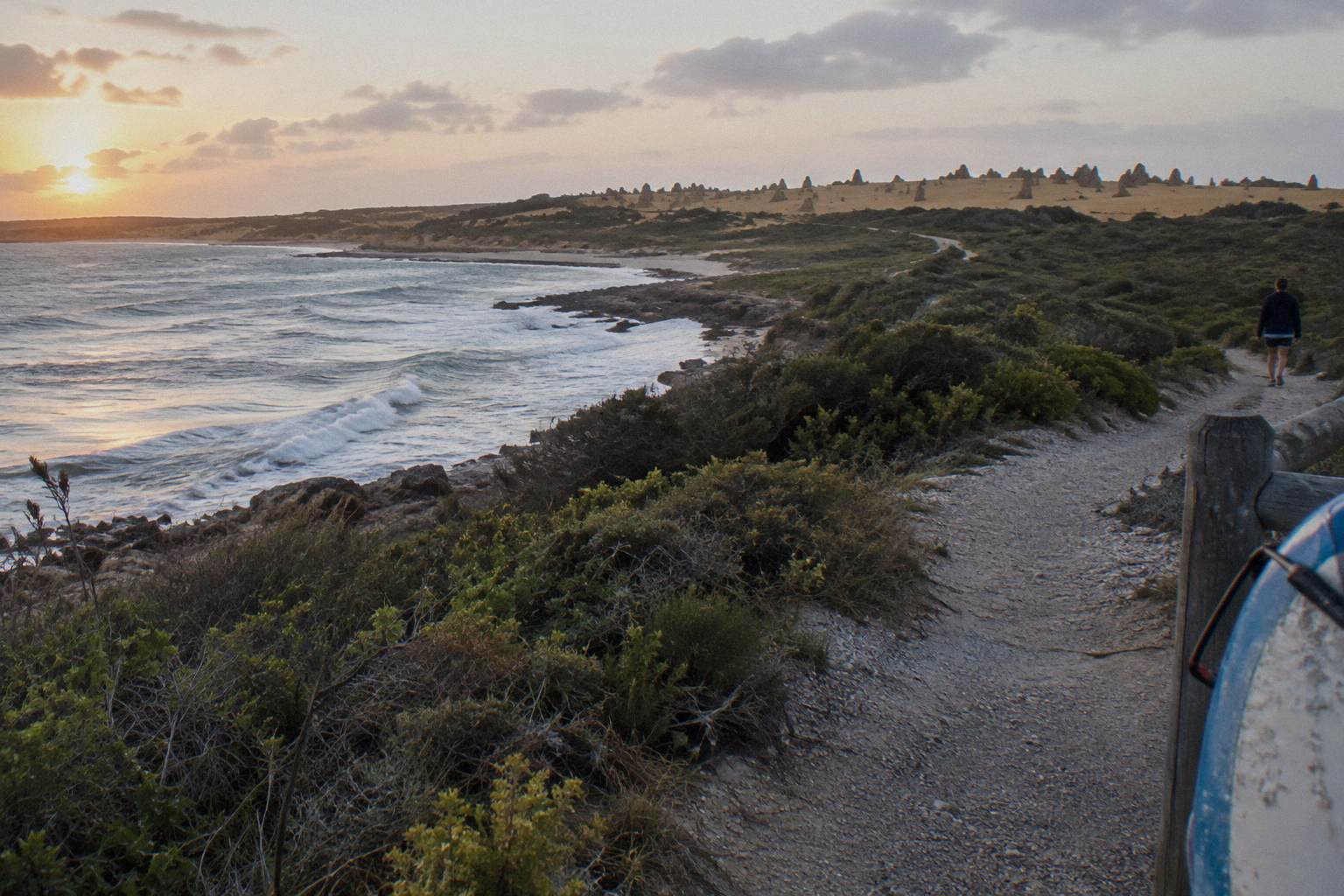
Perth sits roughly 200 km south of the Pinnacles, far enough that its light dome sits low on the southern horizon rather than overhead, and astronomy club guides rate the area among the darkest within easy reach of the city. DBCA publishes no dark-sky rating for Nambung, so there is no official class to quote, but the site is genuinely dark by capital-city standards, and cloud and moon still decide the night.
The distance is the whole story. Light pollution fades with distance from its source, and 200 km puts Perth's glow behind the horizon for anything more than a few degrees up the sky. Club and retailer guides rate the Pinnacles at the darkest end of their scales, and those are the sources that exist: there is no government sky-quality measurement for the park, and any tour copy implying a certified dark-sky status is borrowing a number nobody official has produced. The realistic expectation is a sky full of stars when conditions allow, not a guarantee.
For photography-minded readers, that darkness has a practical consequence: long exposures of the pillars against the sky work here in a way they simply do not within sight of a city. The photographing the Pinnacles guide covers light and timing across the whole day, including the after-dark window. And for the question of which months give the best odds, the sky depends on season and moon in ways the best time to visit guide sets out month by month alongside the BoM averages for the coast.
What A Night Departure Actually Looks Like Hour By Hour
A shared night tour from Perth is a long evening built backwards from sunset: pickup in the city, a drive north of roughly 2 hours with stops on the way, arrival at the Pinnacles for the low sun, dinner, then the after-dark segment, and the drive home. Durations run about 9 hours to 9 hours 30 minutes door to door. Start times are chosen on the booking calendar, not printed in an ad.
The shape of the evening follows the sun, so the clock time of everything shifts with the season. What does not shift is the sequence. The Lumineer sunset dinner stargazing tour, at 9 hours 30 minutes the longest of the shared options, includes park entry, CBD hotel pickup, sandboarding, a meal and stargazing, with children from age 2. Autopia's small-group experience, 9 hours and minimum age 6, runs park entry, inner-city pickup points and a meal. The Wildlife Tours Australia adventure matches that 9-hour span from AU$174 per person with sandboarding-style activity folded into its sunset segment.
Two routes add stops that break up the drive. Trips in the koala family call at Yanchep National Park's koala boardwalk on the way north, where entry is AU$17 per vehicle for independent visitors, and the Yanchep koalas guide explains how that park connects to the Pinnacles route. Trips in the dune family call at Lancelin for sandboarding, covered in the Lancelin sandboarding guide. A night tour with either stop is a full-day commitment that ends very late, which is the single most common surprise for travellers who picture it as an evening out.
For travellers weighing the group size question, small group or coach for a Pinnacles day trip lays out the differences in vehicle, pace and price, and the same logic applies to the night departures.
What Trips People Up Before You Book
Four things catch night-trip planners: assuming stars are guaranteed, underestimating the total day length, ignoring the minimum age, and skipping the moon phase when picking a date. A 9-hour departure that ends after midnight is not an evening excursion, a minimum age of 6 on one product is 2 on another, and a bright moon changes the sky more than a week of weather. Each is checkable before booking.
The stars assumption is the big one. Operators run in all weather because the sunset, the pillars, the dinner and the drive are real regardless, and the sky is the variable. Booking near a new moon tilts the odds; checking the forecast in the final 24 hours, when free cancellation still applies, tilts them further. The length assumption is second: from-AU$199 options are not cheaper evenings, they are the same 9-hour day, so plan the following morning accordingly, especially with children, a question explored in whether a Pinnacles day trip is too long for children.
Age and pickup are quieter traps. Minimum ages across the night category are 2, 3, 4 and 6 depending on the product, so a family with a 4-year-old has two shared options and is excluded from two others. Pickup points differ too: some products collect from designated CBD hotels, others from selected inner-city points, and one, the Autopia lobster day tour family, excludes CBD pickup altogether, though that is a daytime product. Check the booking page for the pickup detail on the specific night departure before assuming your hotel is covered, and see dates there too, because calendar availability, not the headline price, is what constrains a weekend plan.
Common Questions About Visiting The Pinnacles After Dark
Can You See The Milky Way At The Pinnacles Desert?
Conditions at the Pinnacles can be dark enough for it, since Perth's glow is distant and astronomy clubs rate the area very dark. But whether it appears on any given night depends on cloud cover, moon phase and season, so no visit or tour can promise it. Choosing a date near a new moon in the clearer cooler months gives the best odds.
Is It Safe To Drive To The Pinnacles At Night?
The access roads are suitable for two-wheel drive vehicles. The considerations are fatigue, wildlife on country roads and patchy or absent mobile coverage in parts of the park. DBCA recommends the Emergency+ app, which provides your GPS location when there is no coverage to call 000. A full tank, water and a planned route matter more at night.
How Long Do Night Tours From Perth Take?
The shared sunset and stargazing departures run about 9 hours to 9 hours 30 minutes door to door, including pickup, the roughly 2 hour drive north, the sunset stop, dinner and the after-dark segment. The private sunset and stargazing format runs 8 to 12 hours. Start times are set on the booking calendar for each date.
Do You Need To Book A Pinnacles Night Tour In Advance?
Advance booking is the safe approach, because night departures are a limited set and weekend dates fill first. Every product in the category offers free cancellation up to 24 hours before start, so a date can be held early and adjusted if the forecast turns. The booking page shows live availability for each departure.
Is The Pinnacles Desert Open At Night?
The park is open year round. The visitor facility, Pinnacles Desert Discovery, keeps daytime hours of 9:30 am to 4:30 pm daily except Christmas Day, so a night visit is self-guided or on a tour. There is no camping in Nambung National Park; the nearest accommodation is in Cervantes and Jurien Bay.
What Does A Night Tour Cost From Perth?
Shared sunset and stargazing tours run from AU$174 per person for the Wildlife Tours Australia adventure, from AU$199 for Autopia's small-group dinner experience, from AU$220 for the Lumineer sunset dinner stargazing tour and from AU$249 for Australian Pinnacle Tours' night-time stargazing departure. All amounts are Australian dollars and vary by date; the booking page shows the price for each date.
The night visits that work best are the ones planned around what the sky actually depends on rather than what a brochure implies. For the full set of departures in one place, the sunset and stargazing category gathers every night option, and Pinnacles Desert Tours keeps the planning guides and the departures together.
Whether the choice is a shared dinner departure or a private lobster-dinner format, the decision content is the same: pick the date around the moon, hold it with free cancellation, and let the drive home be someone else's. The Private Pinnacles Sunset and Stargazing Tour with Lobster Dinner runs from AU$700 per person over 8 to 12 hours with pickup and drop-off included; its details sit on the booking page.