What Is Special About The Pinnacles?
Thousands of limestone pillars formed from ancient sea shells rise from yellow sand two hours north of Perth. Here is what makes the Pinnacles geologically rare, and how to see them.
The Pinnacles sit inside Nambung National Park, and most visitors reach them on a guided day trip from Perth. If a sunset-and-stars format appeals, the sunset and stargazing tours compared guide lays out every departure that times the pillars for late light and dark skies side by side.
| Fact | Detail |
|---|---|
| What they are | Thousands of limestone pillars rising from yellow sand |
| Tallest pillars | Up to about 3.5 metres |
| Formation material | Ancient sea shells broken into lime-rich sand |
| Location | Nambung National Park, about 200 km north of Perth |
| Traditional Owners | Yued people |
| Drive trail | About 4.5 km one way, unsealed |
| Walk trail | Desert View Walk Trail, 1.5 km |
| Visitor centre | Open 9:30 am to 4:30 pm daily, closed Christmas Day |
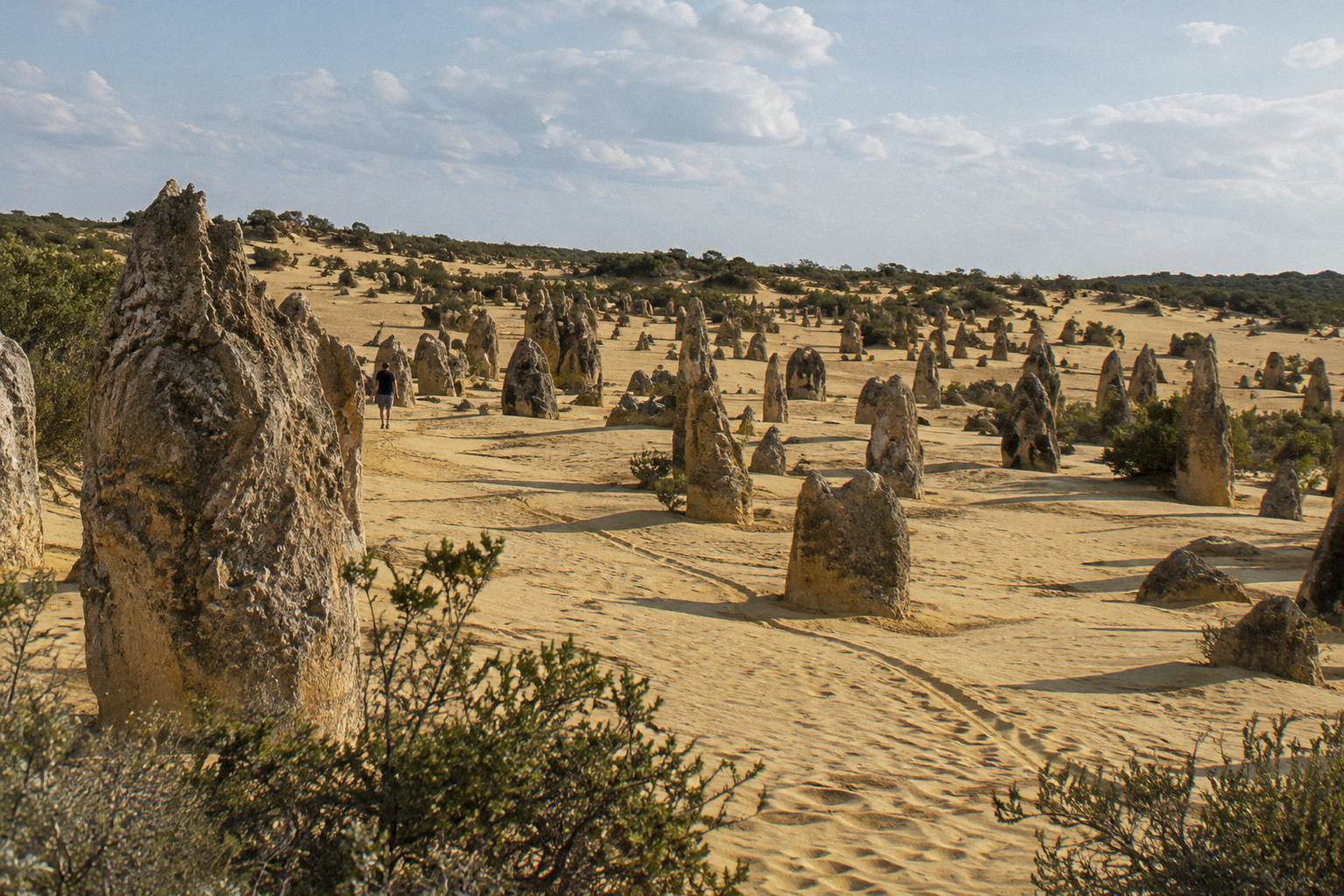
The Pinnacles are a field of thousands of limestone pillars that stand directly on open yellow sand, some reaching up to about 3.5 metres tall, in Nambung National Park roughly 200 km north of Perth. There is no vegetation curtain, no canyon wall and no boardwalk: jagged columns and rounded tombstone forms sit on bare sand, reading as a stone forest. The Yued people are the Traditional Owners of the park.
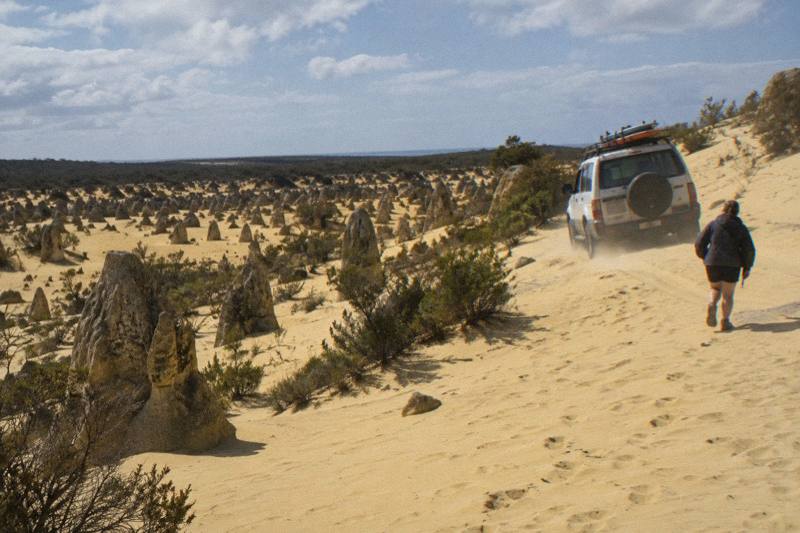
The landscape works because of contrast. Jagged, sharp-edged columns stand beside rounded forms that resemble tombstones, and the whole assembly sits on sand the colour of ripe wheat. The Department's visitor centre, Pinnacles Desert Discovery, sits at the edge of the field with a lookout directly behind it, so the scale of the place is visible within a minute of arriving. From there a drive trail winds about 4.5 km one way through the pillars with parking bays, and a separate 1.5 km walking track puts you among them on foot.
What surprises many first-time visitors is how small the driving loop feels against the walking experience. The road gives you the sweep; the walk gives you the detail, the cross-bedding in the stone, the mushroom caps, the plant roots that helped shape them. On Pinnacles Desert Tours, the format that shows both faces of the field is the sunset departure: it walks or drives the pillars in late light, then stays for dinner and stargazing, since the site's distance from Perth's glow makes the night sky part of the appeal.
Three products frame the range of ways to see the field. The "Pinnacles Desert Sunset Dinner and Stargazing Tour" by Lumineer Adventure Tours runs from AU$220 per person for 9 hours 30 minutes, rated 4.8 from 1,155 reviews, with park entry, Perth CBD pickup, sandboarding, a meal and stargazing included. The "Pinnacles Desert Lobster Tour from Perth" by Wildlife Tours Australia is a daytime format from AU$174 per person over 9 hours 30 minutes, with park entry and inner-city pickup included and a meal excluded. The "Pinnacles Sunset Stargazing Dinner Experience Small Group Tour" by Autopia Tours sits between them, from AU$199 per person for 9 hours, rated 4.6 from 473 reviews. Amounts are Australian dollars, prices vary by date, and the booking page for each product shows the price for the date you want.
How Did The Limestone Pillars Form?
The pillars formed from ancient sea shells: waves broke shells into lime-rich sand, wind carried that sand inland into high dunes, and winter rain leached lime down through the grains and cemented them into limestone. A hard calcrete cap formed on top, plant roots opened cracks, water dissolved the softer limestone below, and wind stripped away the covering sand to expose the pillars. No official age is published, so the realistic framing is "formed from ancient sea shells".
The Department of Biodiversity, Conservation and Attractions tells the sequence in its Nambung visitor guide, and it is worth reading in order because each stage explains something you can see on site. The shell sand came first, then the dunes, then the cementing, then the exposure. Every pillar you walk past is the residue of that chain: the parts that cemented hardest survived the dissolving, and the sand around them blew away.
| Stage | What happened | What you can see today |
|---|---|---|
| Shell sand | Sea shells broken into lime-rich sand, carried inland by wind into high dunes | The yellow sand underfoot is the same dune system's residue |
| Cementing | Winter rain leached lime downward and cemented sand grains into limestone | The solid limestone body of each pillar |
| Capping | A harder calcrete cap formed over the cemented surface | Mushroom-shaped pillars where the cap outlasted the stem |
| Cracking | Plant roots opened cracks; softer limestone below dissolved | The vertical seams and split columns |
| Exposure | Wind removed the covering sand | Pillars standing free on bare ground |
The cross-bedding is the giveaway of the wind stage. Many pillars show angled layering, which indicates the dunes the limestone formed from were laid down by wind, an inland desert process rather than a seabed one. The DBCA Pinnacles Desert lookout page describes the shapes, the drive trail and the standing rule that visitors never climb on the pinnacles, since the limestone edges are fragile and the columns themselves are the entire point of the place.
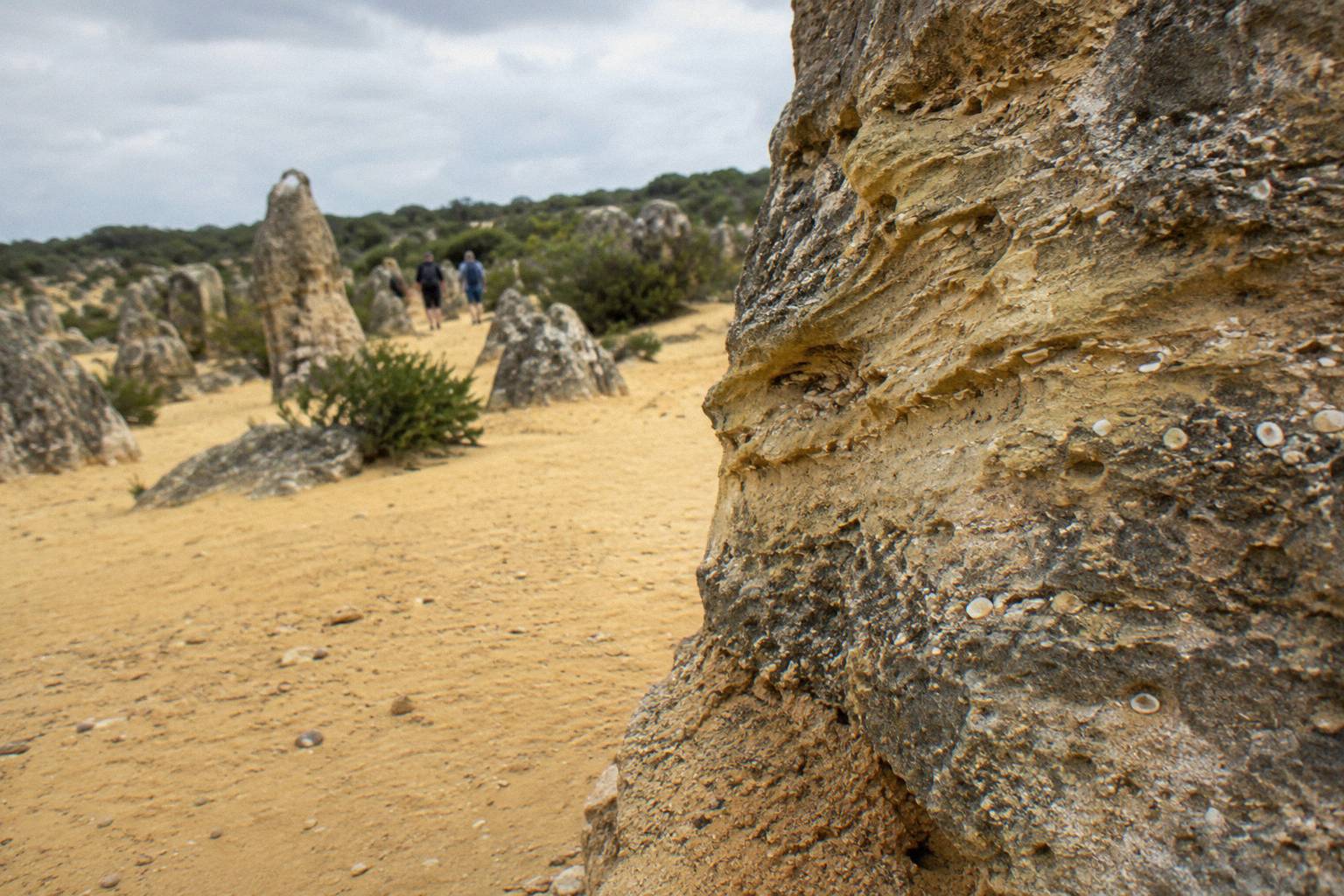
A second Department page, the DBCA Nambung visitor guide, adds the practical geology: the same wind that built the dunes eventually uncovered the pillars, which is why the field has no soil cover at all. That bareness is rare. Most limestone landscapes keep a vegetation skin; the Pinnacles do not, and that is a large part of the visual shock.
Deciding between seeing the sequence in daylight or under stars? The "Pinnacles Desert Sunset Dinner and Stargazing Tour" times the drive for the transition, with a meal between the light and the astronomy session, and free cancellation up to 24 hours before start.
Why Do The Pinnacles Have So Many Shapes?
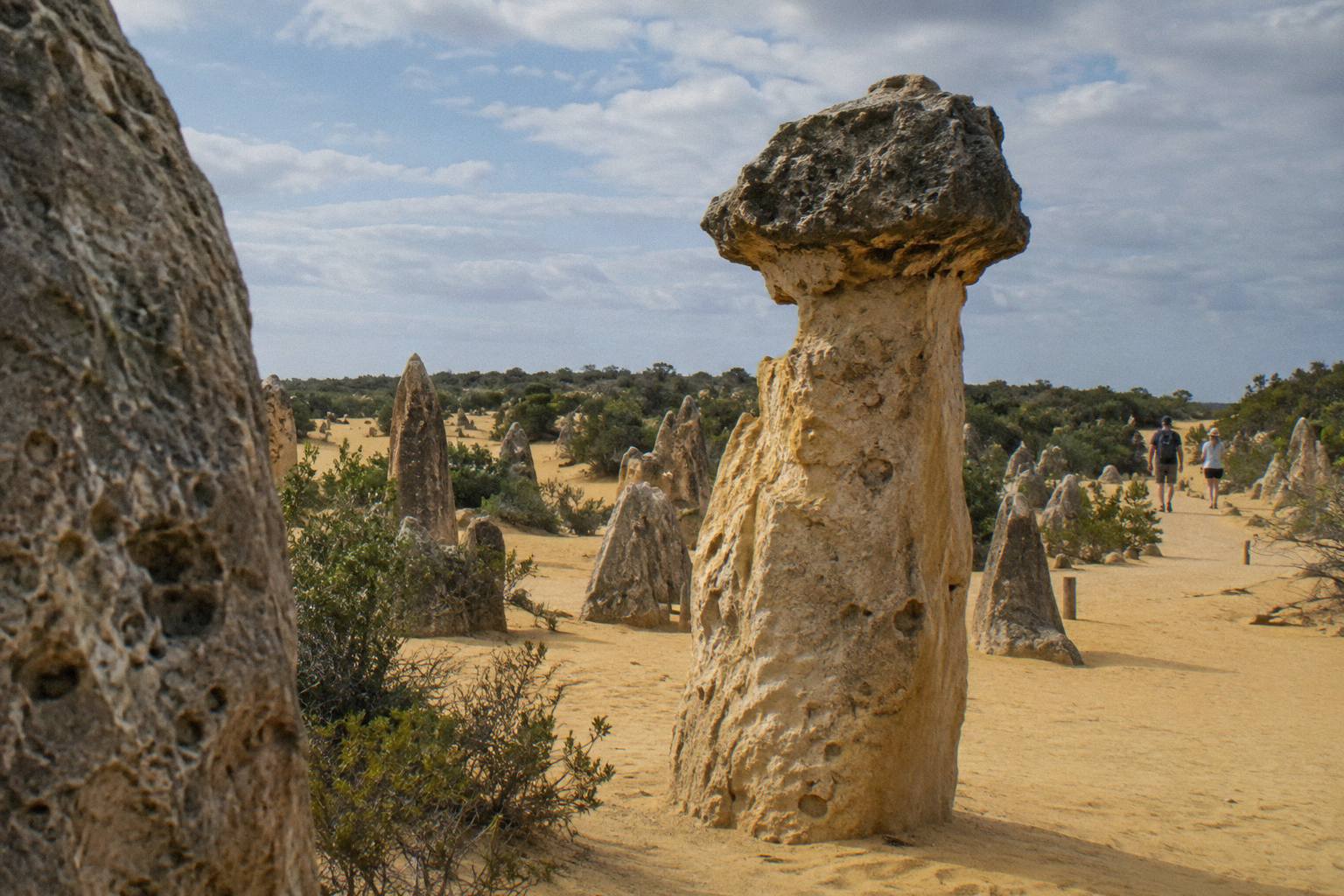
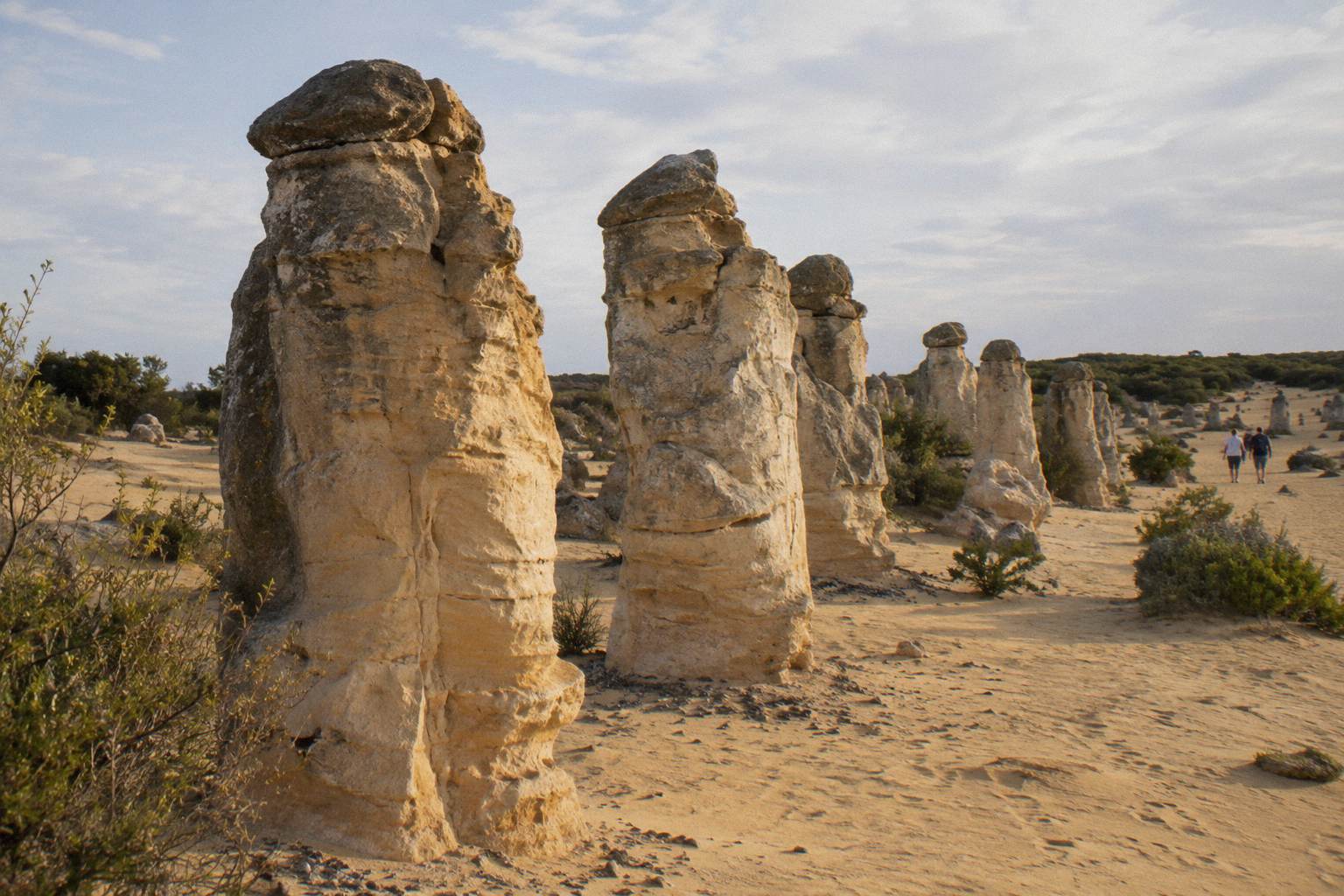
The variety comes from two different weathering processes acting on one limestone body: pillars capped with harder calcrete resist erosion and end up mushroom shaped, while uncapped columns weather unevenly into jagged, sharp-edged forms, and many resemble plain tombstones. Cross-bedding inside the stone adds angled banding that records the ancient dune layers. The result is that no two pillars in the field look alike, and a slow walk reads like a catalogue of limestone forms.
The mushroom shapes are the easiest to explain and the most photographed. A harder calcrete cap weathers more slowly than the limestone below it, so the stem narrows while the cap holds its width. Where no cap formed, the column stays roughly cylindrical or sharpens as rain and wind work the edges. The Department's lookout page lists the categories plainly, and they hold up on the ground.
| Pillar shape | How it formed |
|---|---|
| Jagged, sharp-edged columns | Uneven weathering of uncapped limestone |
| Tombstone forms | Uniform columns that lost their softer sides slowly |
| Mushroom shaped | A harder calcrete cap weathering more slowly than the stem |
| Cross-bedded surfaces | Angled layers recording wind-laid dune sand |
Photographers care about these shapes more than anyone, because the low sun at either end of the day rakes across the angled banding and throws the stems and caps into relief. The photographing the Pinnacles light and timing guide breaks down how the shapes read at different hours, and the Pinnacles at night guide covers what the same pillars become after dark, when the field turns into silhouettes against the sky.
The Wildlife Tours Australia lobster tour is the budget-friendly daytime way among the shapes, from AU$174 per person over 9 hours 30 minutes with park entry and inner-city pickup included; Check availability if the date matters.
Who Are The Traditional Owners Of Nambung National Park?
The Yued people are the Traditional Owners of Nambung National Park, and the Department of Biodiversity, Conservation and Attractions states the acknowledgement directly on the park's official page: "We recognise and acknowledge Yued people as the Traditional Owners of Nambung National Park." For visitors, that acknowledgement is not a footnote; it frames the Pinnacles as a lived cultural landscape rather than an empty geological exhibit, and the visitor centre's displays on heritage sit alongside the geology.
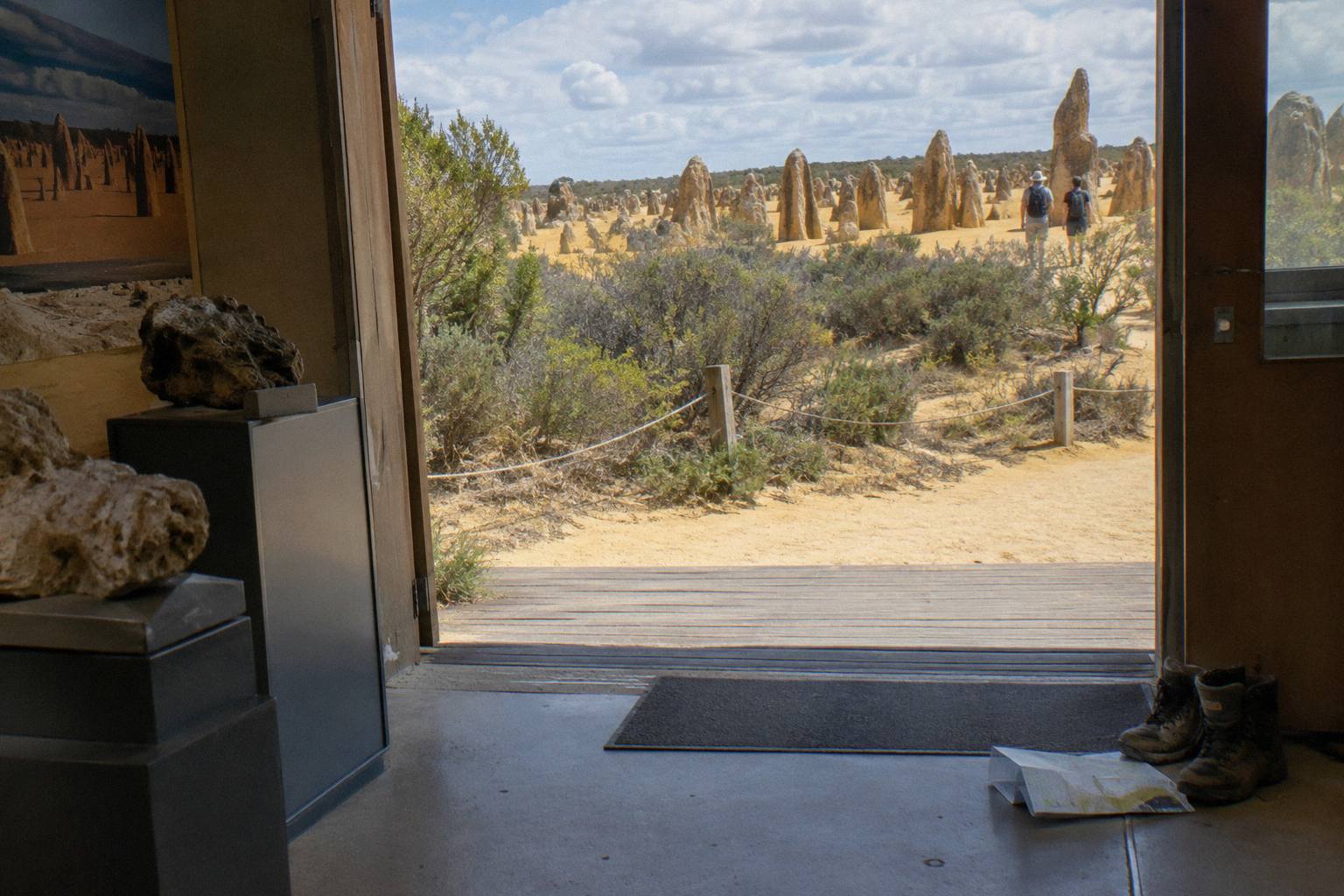
The park's official page carries the acknowledgement alongside the entry fee table and the park rules, which tells you something about how the site is managed: the cultural framing and the practical framing travel together. Inside Pinnacles Desert Discovery, displays, soundscapes, videos and objects cover both geology and heritage, so a visitor who arrives knowing only the pillar photographs leaves with the fuller story.
Respecting the site in practice comes down to the Department's standing rules. Never climb on the pinnacles, since the limestone and its calcrete caps are the irreparable asset. No dogs or other pets are allowed in the park. Mobile coverage is patchy or absent in parts, and the visitor guide recommends the Emergency+ app, noting: "If there is no mobile phone coverage you WILL NOT be able to call 000 but the app will provide you with your GPS location." The official Nambung National Park page holds the current rules and fees.
What Can You Actually Do At The Pinnacles?
Two built experiences structure a visit: the drive trail, about 4.5 km one way and unsealed, winds through the pillar field with parking bays, and the Desert View Walk Trail runs 1.5 km, starting with a 300 m Class 1 accessible path before continuing as a 1.2 km Class 3 sandy trail. Vehicles longer than 7 m, caravans and trailers are not permitted on the loop, though the access roads otherwise suit two-wheel drives.
The split between the two matters for planning. The drive trail delivers the panorama and suits anyone, with bays to stop and absorb the scale. The walk trail delivers intimacy, and its first 300 m is built to an accessible standard, so wheelchair users and strollers reach a real viewing platform rather than a token corner. The remaining 1.2 km is Class 3 and sandy, which means soft going and ordinary shoes rather than thongs.
Beyond the pillars themselves, the park spreads to the coast. Lake Thetis holds living stromatolites, microbial structures that resemble the earliest forms of life on Earth, at densities of 3000 per square metre. Hangover Bay offers a wide sandy beach with snorkelling and swimming inside the Jurien Bay Marine Park, plus barbecue and picnic facilities. The Cervantes, Lake Thetis and Hangover Bay guide covers how the coastal stops chain onto a Pinnacles day, and the Nambung National Park visitor guide lays out the full park.
Guided products handle the driving and the timing. The Autopia small-group sunset tour runs from AU$199 per person over 9 hours, rated 4.6 from 473 reviews, with park entry, Perth CBD pickup and a meal included; see dates on the operator's calendar before locking plans.
What Makes The Pinnacles Different From Other Desert Landscapes?
Most deserts impress through scale, dunes or canyons; the Pinnacles impress through density of odd objects, thousands of limestone pillars packed onto flat, vegetation-free sand. They are not a dune field you ride, nor a canyon you descend, and pale limestone against yellow sand gives a palette closer to a beach than a desert, which is geologically accurate: the stone began as sea shells.
That beach origin is the conceptual hook. The shells were marine, the dunes were wind-built, the cementing was rain-driven, and the exposure was wind again. Four agents, one landscape, and each one legible in the finished pillars. The cross-bedding records the wind, the calcrete caps record the rain chemistry, and the bare ground records the final stripping.
The other distinction is the night sky. Astronomy club and retailer guides rate the area's darkness highly because Perth's glow is distant, and the cooler months from about March to October tend to deliver the clearest conditions. The Department publishes no dark-sky statement of its own, so treat the darkness as a strong tendency rather than a guarantee, and check the moon phase before booking anything astronomy-heavy. The Milky Way at the Pinnacles guide and the best months and moon phases guide work through the timing in detail.
When Is The Best Time To See Them?
The park is open year round with all-year interest, but the practical windows differ by purpose: wildflowers run August to October per the Department, with Coral Coast tourism putting the peak at August to September, and the cooler months around March to October tend to give the clearest night skies. Summer from December to March is hot and dry with extreme fire danger possible, and the Department advises carrying a personal location beacon in that season.
The climate record for the nearest full station, Jurien Bay, shows why winter is a quiet visitor period: June averages 106.6 mm of rain and July 111.1 mm, against December's 6.0 mm. Mean maximums sit near 30 degrees in January and February and drop to the high teens in July, so the walking trail is far more pleasant in the shoulder months. Rainfall shapes the wildflowers too, since amounts vary with what fell in the preceding months.
For a sunset departure, the geometry of light changes through the year without needing any clock time at all: winter sun sits low and northern, summer sun higher and southern, and the pillar shadows respond accordingly. The best time to visit guide compares the seasons, and the sunset times by month guide tracks the light for photographers.
What Trips People Up Before You Visit
The recurring mistakes are treating the Pinnacles as a quick roadside stop, expecting shade and facilities inside the pillar field, not checking the moon phase before a stargazing plan, and assuming a tour price includes park entry when the inclusions do not say so. The drive from Perth CBD to Cervantes is about 197 km, roughly two hours, and Cervantes to the Pinnacles is another 15 to 20 minutes.
The entry-fee question deserves precision. The 2026 fee table charges AU$17 per vehicle for a standard vehicle of 12 or fewer occupants, and commercial tour passengers pay a Department operator fee of AU$8 per person, with children under 6 free. Whether a given tour's price includes entry is stated per product: the Lumineer sunset tour includes park entry, the Autopia small-group tour includes park entry, and the Wildlife Tours Australia lobster tour includes park entry too. Where a product's inclusions do not name entry, ask the operator before assuming.
Timing errors are the second category. A midday arrival in summer meets hot sand and flat light; a stargazing booking near a full moon meets a bright sky. Neither ruins a visit, but both disappoint expectations that a small amount of planning would have corrected. Check the booking calendar for start times rather than guessing, since departures are chosen on the calendar, and the free-cancellation window on the shared tours runs to 24 hours before start.
Three departures cover most intentions: the sunset dinner and stargazing format for the full light-to-dark arc, the lobster day tour for a coastal daytime loop, and the small-group sunset dinner for a mid-price shared option. All amounts are Australian dollars, prices vary by date and group, and the booking page for each product shows the price for the date you want.
Common Questions About The Pinnacles
What Is Special About The Pinnacles?
Thousands of limestone pillars, some up to about 3.5 metres tall, stand directly on bare yellow sand in Nambung National Park. They formed from ancient sea shells: wind carried shell sand inland into dunes, rain cemented it into limestone, and wind later exposed the pillars. The Yued people are the Traditional Owners of the park.
How Tall Do The Pinnacles Get?
The Department's lookout page describes pillars reaching up to about 3.5 metres. Most are shorter, and the variety of heights and shapes, from jagged columns to tombstone forms and mushroom caps, is part of what makes the field visually dense.
Can You Walk Among The Pillars?
Yes. The Desert View Walk Trail runs 1.5 km, starting with a 300 m Class 1 accessible path to a viewing platform, then a 1.2 km Class 3 sandy trail among the pillars. Visitors are asked never to climb on the pinnacles, as the limestone is fragile.
Is The Pinnacles Drive Trail Suitable For All Vehicles?
The loop is about 4.5 km one way and unsealed, and vehicles longer than 7 m, caravans and trailers are not permitted on it. Access roads to the park's recreation sites otherwise suit two-wheel drive vehicles, trailers, caravans and buses.
How Old Are The Pinnacles?
No official numeric age is published for the formations. The safe description is that they formed from ancient sea shells through wind, rain and time, with the Department's visitor guide describing the sequence rather than a date.
What Is Near The Pinnacles?
Cervantes is the gateway town, about 17 to 19 km and 15 to 20 minutes from the pillars. Inside the park, Lake Thetis holds living stromatolites and Hangover Bay offers a beach in the Jurien Bay Marine Park. There is no camping in the park; the nearest accommodation is in Cervantes and Jurien Bay.