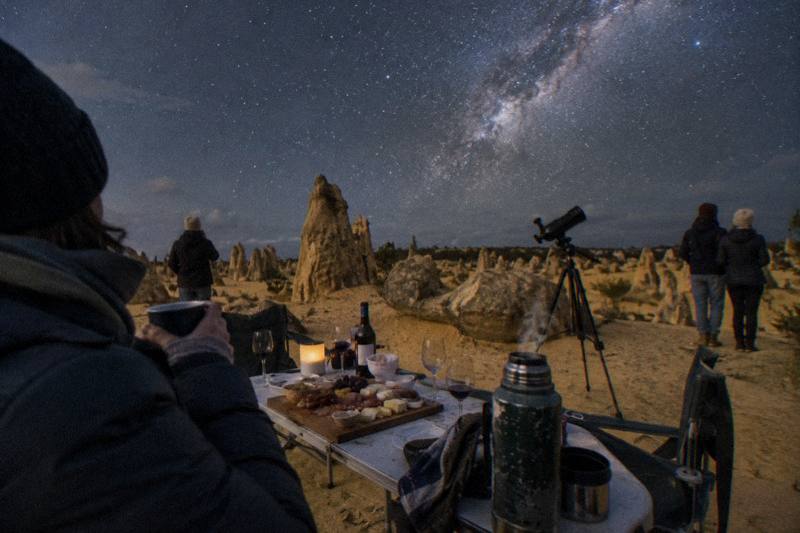
Milky Way At The Pinnacles: When And How To See It
The Pinnacles sit far from Perth's light dome, and on a moonless night in the cooler months the Milky Way can stretch overhead. Here is what sets the conditions, and how a stargazing tour fits in.
Short answer
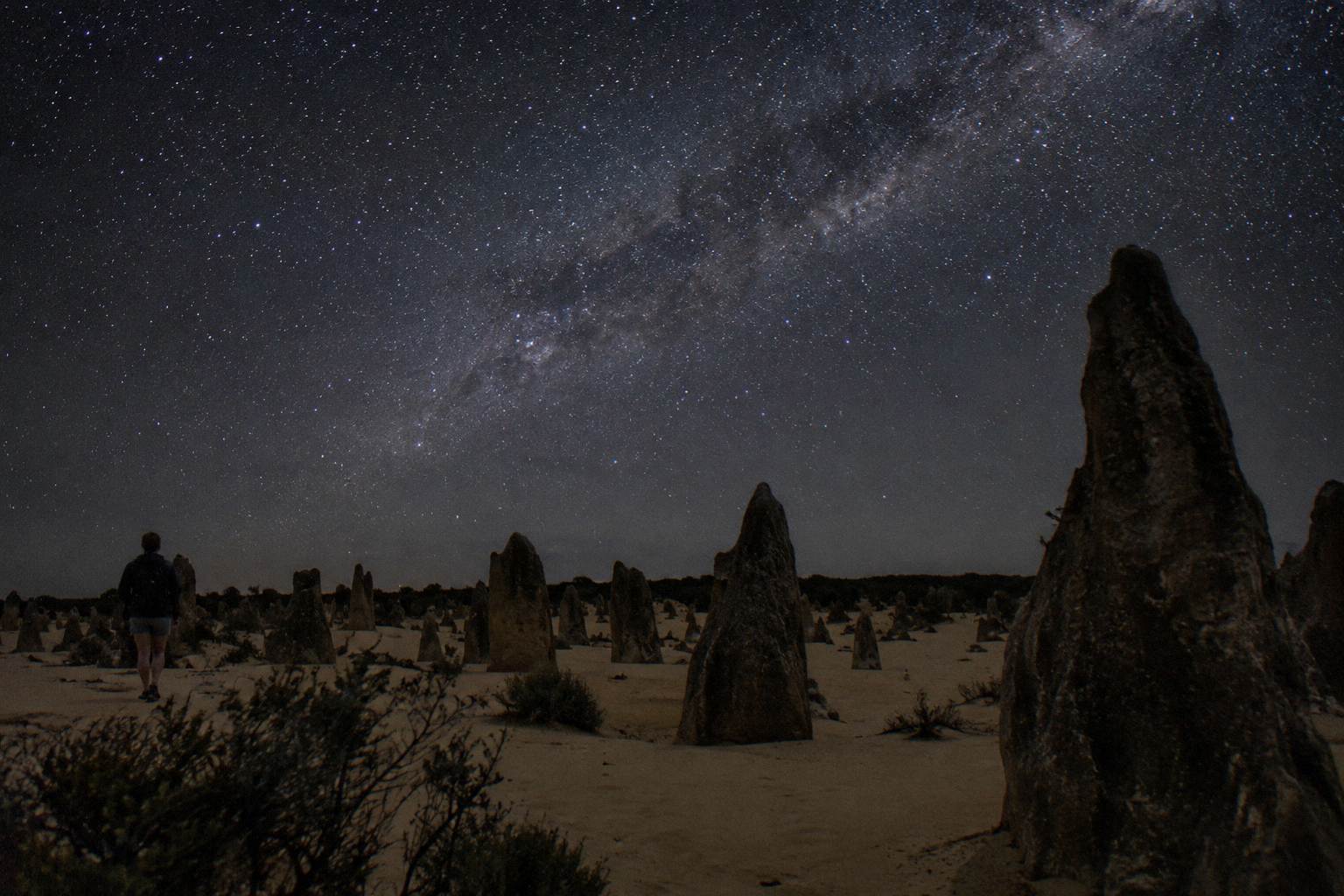
Yes, the Milky Way is visible from the Pinnacles on clear, moonless nights. Astronomy club guides rate the area at Bortle 1 to 2 and say viewing is best near new moon, clearest in the cooler months from about March to October. Rainfall, cloud and moonlight decide each night, so no view can be promised.
The Pinnacles Desert is one of the closer genuinely dark skies to Perth, and most nights the pillars are visited on wheels rather than on foot. The stargazing side of a visit is largely a decision about the Lumineer sunset dinner stargazing tour: shared departures run out from the city, time the arrival for dusk and stay past dark. This page is about the Milky Way itself, what governs whether it appears, and how to pick the night. For the full month-by-month calendar and moon-phase planning, see the companion best stargazing months and moon phases guide.
| Fact | Detail |
|---|---|
| Sky quality | Astronomy club and retailer guides rate the Pinnacles at Bortle 1 to 2 |
| Best lunar window | Near new moon, per astronomy club guides |
| Clearest season | Cooler months, about March to October, per astronomy club guides |
| Nearest full climate record | Bureau of Meteorology Jurien Bay station, 1968 to present |
| Wettest months at Jurien Bay | June 106.6 mm and July 111.1 mm mean rainfall |
| Driest month at Jurien Bay | December, 6.0 mm mean rainfall |
| Distance from Perth's glow | Perth's light dome is distant from the Pinnacles |
| Guided access at night | Shared sunset and stargazing tours from Perth |
Can You See The Milky Way From The Pinnacles?
Yes, the Milky Way can be seen from the Pinnacles on a clear, moonless night, and the site's distance from Perth's light dome makes it possible. Astronomy club and retailer guides rate the sky there at Bortle 1 to 2, among the darkest classifications used by amateur astronomers. Those guides add two conditions that decide any given night: the moon phase and the cloud cover. Neither is guaranteed, and no tour can promise a Milky Way view.
The Bortle scale is a nine-step measure of night-sky darkness, with Class 1 the darkest. A rating of 1 to 2 places the Pinnacles among the better skies within reach of a major Australian city, because the park sits roughly 200 km north of Perth and its glow is distant. Astronomy club guides add the practical qualifier that matters most: the Milky Way is best near new moon, and skies are typically clearest in the cooler months, about March to October. Those are club and retailer observations, not a park-service measurement, so treat them as experienced guidance rather than a guarantee.
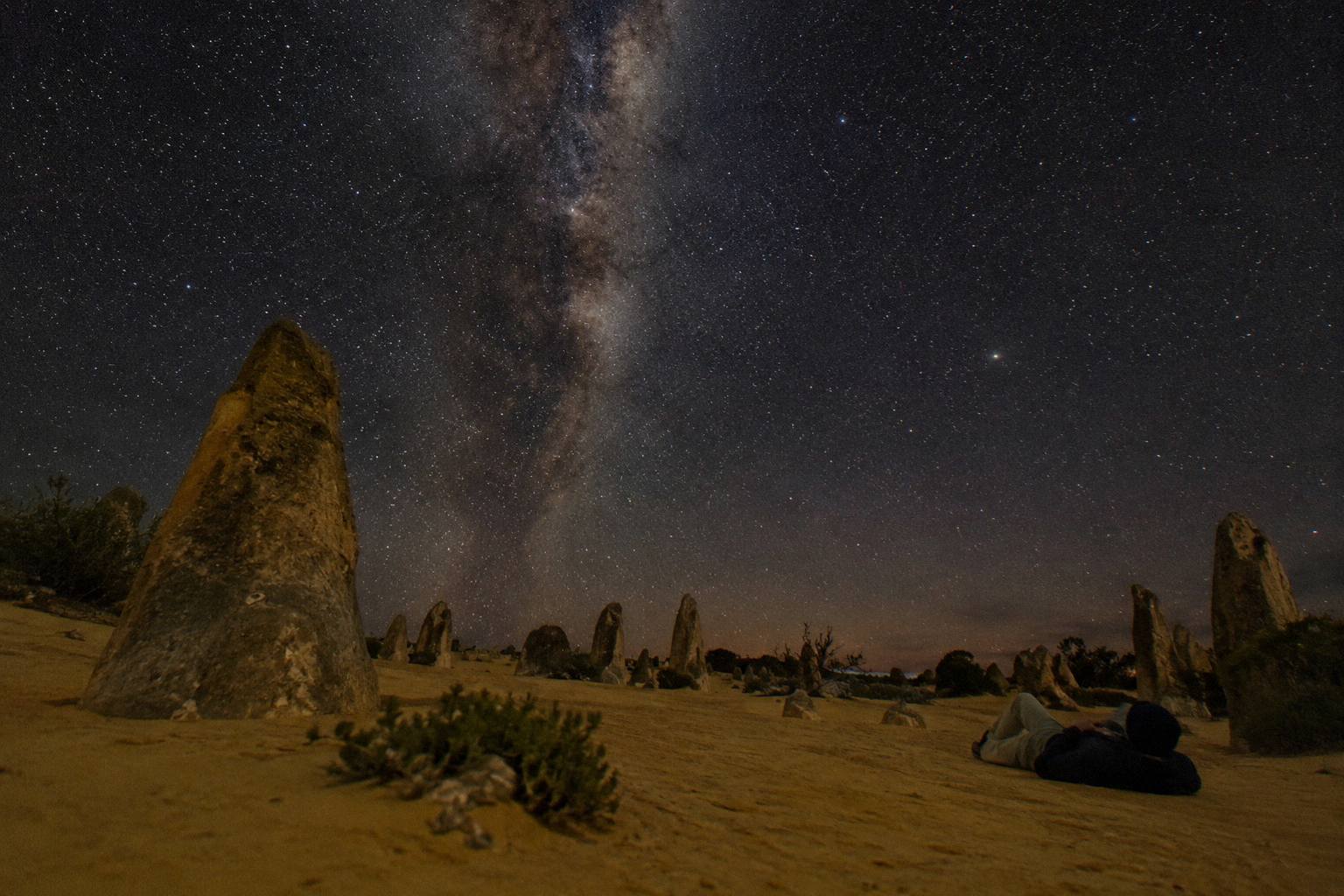
What that means in practice is that a Pinnacles night is a conditions question. A moonless, cloud-free night in the cooler months offers the strongest odds. A bright moon, a summer haze or a winter front can wash the band of the Milky Way out entirely even though the stars above the pillars remain. The pillars themselves, some up to about 3.5 metres tall, are the foreground: the DBCA Pinnacles Desert lookout page describes them, and reminds visitors never to climb on them, day or night.
Which Months Give The Clearest Milky Way Nights?
March through October is the window astronomy club guides point to for the clearest Milky Way nights at Pinnacles, and it matches the region's rainfall pattern. Bureau of Meteorology records from Jurien Bay show mean rainfall peaking at 111.1 mm in July, while December averages just 6.0 mm, though clarity and dryness are related but not identical since winter fronts bring both rain and cooler, often clearer air.
The rainfall numbers deserve a closer read, because the wettest months sit inside the clearest season. June and July deliver the most rain, but that rain arrives in fronts rather than continual monsoon, and the air between systems in winter is frequently transparent. The Bureau of Meteorology Jurien Bay table gives the monthly means: January 30.1 degrees max and 7.3 mm of rain, April 26.4 and 29.1 mm, July 19.6 and 111.1 mm, October 23.4 and 26.4 mm. Summer is dry but hazier and hotter; the park's own visitor material notes summer can bring extreme fire danger.
| Season | Months | Mean max temp (Jurien Bay) | Mean rainfall | Milky Way outlook |
|---|---|---|---|---|
| Late summer to early autumn | March to April | 29.5 and 26.4 °C | 15.1 and 29.1 mm | Clearest air begins, mild nights |
| Mid autumn to early winter | May to June | 23.4 and 20.6 °C | 73.3 and 106.6 mm | Cool and clear between rain fronts |
| Winter proper | July to August | 19.6 and 20.1 °C | 111.1 and 82.2 mm | Coldest nights, wettest months, transparent air between fronts |
| Spring | September to October | 21.4 and 23.4 °C | 41.8 and 26.4 mm | drying out, mild evenings, within the club-guided window |
For the month-by-month moon calendar and how to pick a date around a new moon, the stargazing months and moon phases guide carries that planning detail; this page stays on the sky itself. The short version for a Milky Way question: pick a night inside the March to October window, as close to a new moon as your travel dates allow, and keep a fallback evening free in case a front rolls through.
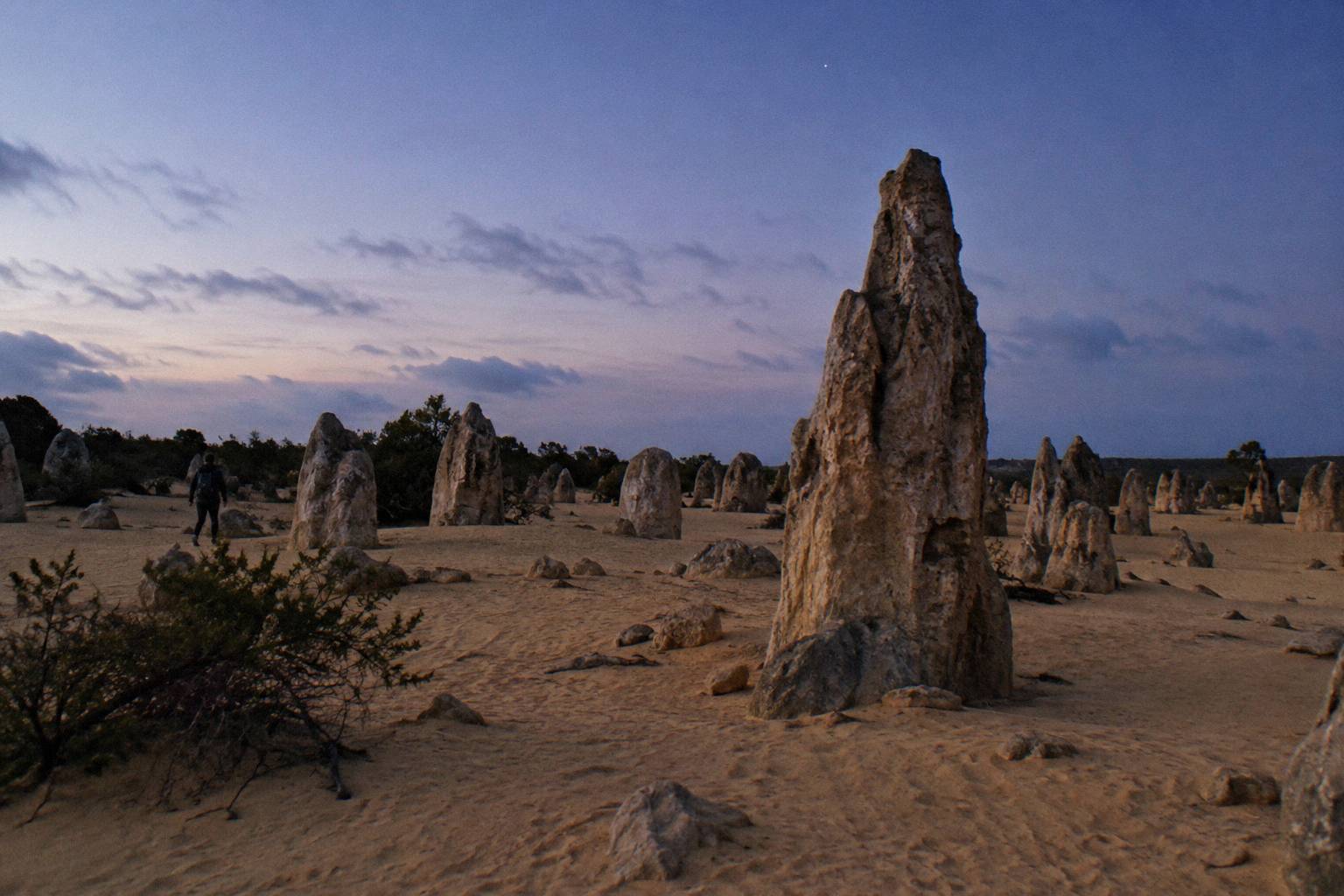
Three shared departures do the after-dark work for you, with dinner folded into the evening.
The "Pinnacles Desert Sunset Dinner and Stargazing Tour" from Lumineer Adventure Tours runs about 9 hours 30 minutes from AU$220 per person, with park entry, Perth CBD hotel pickup, sandboarding, a meal and stargazing named as included, and a 4.8 rating from 1,155 reviews. Amounts shown across this page are Australian dollars, and prices vary by date, so check the live price for your night. It is a strong fit for a Milky Way question because stargazing is a named inclusion rather than an incidental stop.
How Much Does The Moon Phase Change The View?
The moon phase is the single biggest controllable factor in whether the Milky Way appears. Astronomy club guides put it plainly: the Milky Way is best near new moon. In the nights either side of a full moon, moonlight brightens the whole sky and the faint band of the Milky Way fades first, leaving only the brighter stars. A new-moon window of roughly a week each month is when the darkest conditions line up.
The mechanics are simple. The Milky Way's band is made of faint, diffuse light from millions of unresolved stars, and any significant sky brightness swallows it. Moonlight does exactly that, and the effect strengthens as the moon waxes toward full. Under a gibbous or full moon the pillars remain striking, the brighter constellations hold, but the diffuse band that most visitors mean when they say "Milky Way" can vanish entirely. Under a new moon, with no cloud, the same sky can show the band clearly enough to cast soft shadows on the sand.
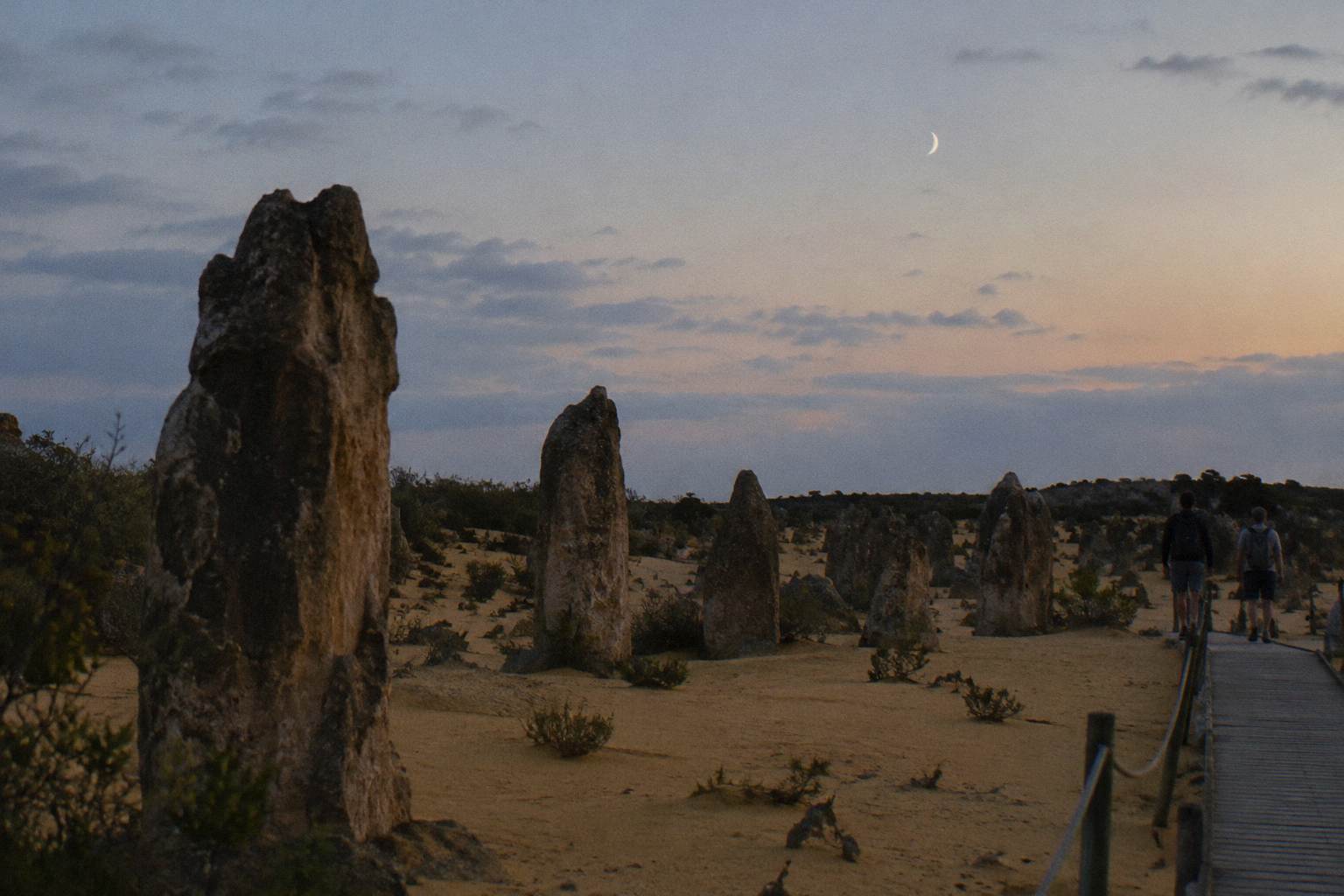
| Moon phase | Effect on the Milky Way | What still shows |
|---|---|---|
| New moon | Darkest sky, the band at its strongest when cloud-free | The full band, faint nebulae to the eye, dense star fields |
| Crescent (thin) | Minor brightening in the west after dusk | Band still clear for most of the night |
| Quarter | Noticeable wash, band fades in moonlit half of sky | Bright stars, constellations, the pillars lit by moonlight |
| Full moon | Sky bright all night, the diffuse band generally lost | Bright stars and planets, a moonlit Pinnacles landscape |
This is why tour timing around the lunar cycle matters more than the date on the calendar. A departure three nights off a full moon in a clear month can show fewer stars than a new-moon night in a marginal one. Operators run to their own schedules, so check the booking calendar for the dates that fall near a new moon, and treat the lunar window as the first filter.
Do You Need A Tour To See The Milky Way There?
No, the park is public land and a self-drive visit is possible, but a guided night solves three problems at once: the 200 km drive home after midnight, navigation of unsealed roads in the dark, and timing the arrival so dusk and full darkness are both covered. A stargazing tour also brings gear and interpretation most visitors do not carry. Whether that is worth paying for depends on confidence driving at night and interest in the astronomy.
The park's access roads, sealed and unsealed, are suitable for two-wheel drive vehicles, per the DBCA visitor guide, though the lookout drive loop excludes trailers, caravans and vehicles longer than 7 metres. There is no camping in Nambung National Park, and the nearest accommodation is in Cervantes and Jurien Bay, which turns a self-drive Milky Way night into either a very late return to Perth or an overnight stay. Mobile coverage is patchy or absent in parts of the park, and the visitor guide recommends the Emergency+ app for that reason. Those are the real costs of going alone after dark.
A shared tour shifts the arithmetic. The "Pinnacles Sunset Stargazing Dinner Experience Small Group Tour" from Autopia Tours runs about 9 hours from AU$199 per person, includes park entry, inner-city pickup and a meal, has 473 reviews, and sets a minimum age of 6. See dates on the Autopia small-group stargazing tour page if a smaller vehicle suits your group.
For a different style of evening, the "High Tea and Dark Sky Astronomy" experience from Lumineer Adventure Tours pairs a meal with an astronomy program and includes park entry and round-trip transport from Perth; its price and duration are on the booking page. And if the moon phase is against you on the only night you have, the question of what happens when cloud covers the stars is worth reading before you commit.
What Is It Actually Like Standing Under That Sky?
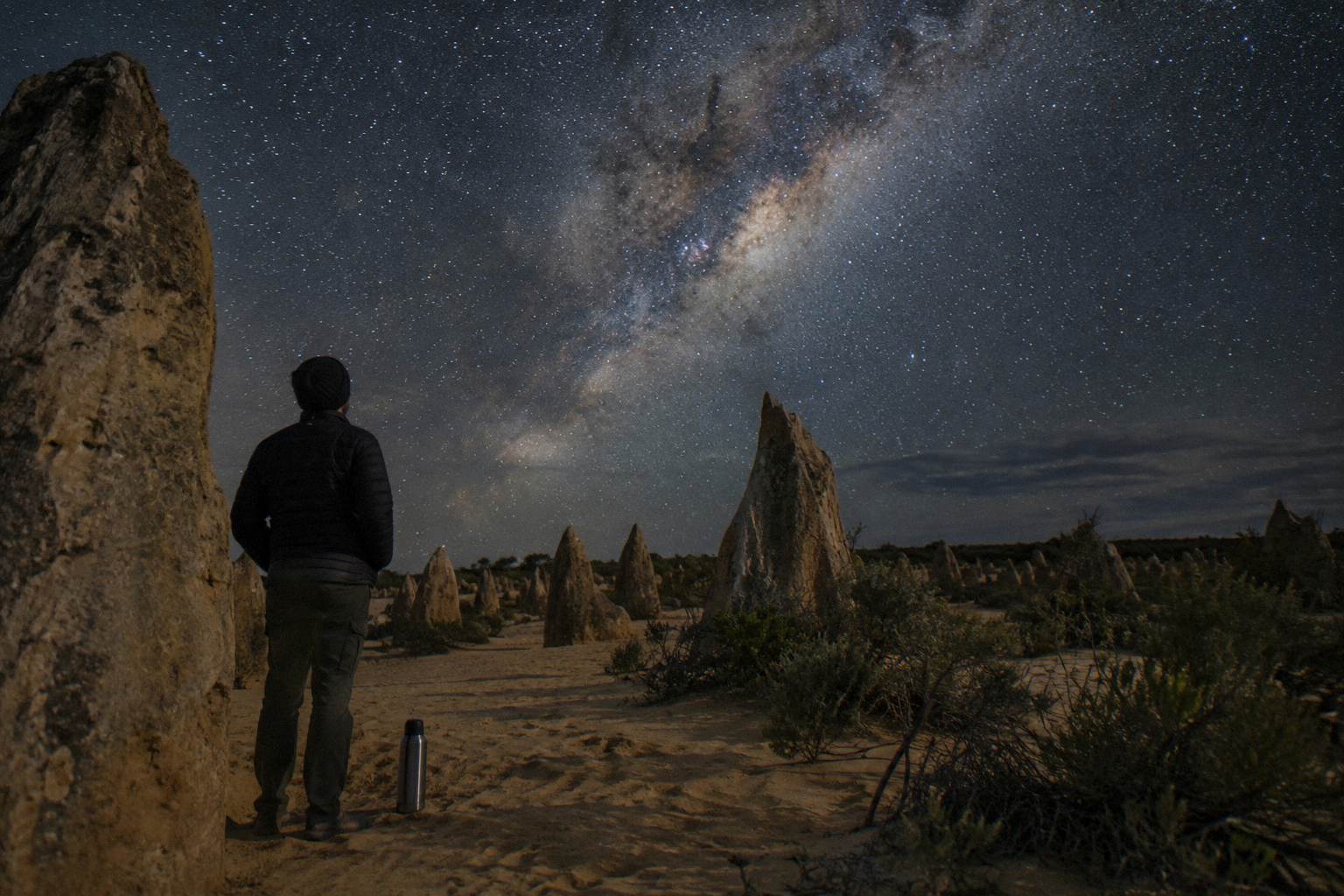
The short answer is that it varies enormously night to night, and that variance is the point of planning around moon and season. On a new-moon night in the cooler months, club guides describe a sky dark enough that the Milky Way's band is the dominant feature overhead. On a moonlit or hazy night, the same location shows a pleasant but ordinary field of brighter stars. The pillars are the constant; the sky above them is the variable.
No first-hand sensation claims belong on a research page like this one, so stick to what the sources support. The DBCA lookout page describes thousands of limestone pillars rising from yellow sand, some jagged and sharp-edged, others mushroom shaped where a harder calcrete cap has weathered more slowly than the limestone beneath. They were formed from ancient sea shells, broken into lime-rich sand, carried inland by wind, cemented by winter rain into limestone, then exposed as wind removed the covering sand. Under a dark sky that landscape becomes a silhouette field, and photographers chase exactly that pairing; the photographing the Pinnacles guide covers the light and timing side.
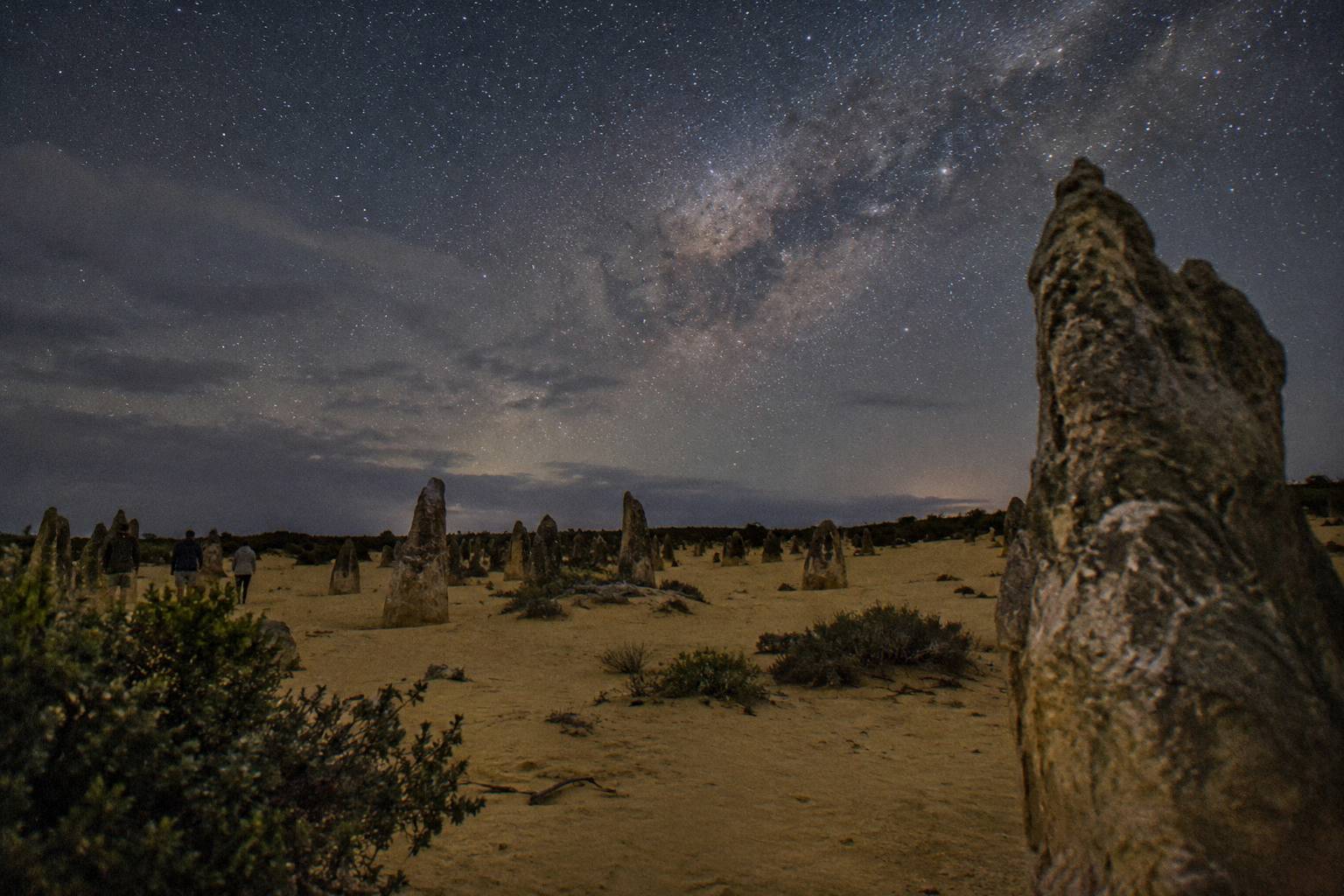
Practical notes for the night itself: dress for the season, since Jurien Bay mean minimums fall to 9.5 degrees in July and August, and the what to wear and bring guide has the full kit list. A red-light torch preserves night vision better than white light, and patience matters, because eyes take fifteen minutes or more to fully adapt to darkness. On any guided departure the operator's schedule governs when the group is on site and how long the dark window lasts.
Which Stargazing Tours Fit A Milky Way Night?
For a Milky Way night, the Lumineer dinner tour from AU$220 per person offers stargazing and sandboarding included, while the Autopia small-group experience from AU$199 per person suits families with children aged 6 and over. If hotel pickup matters most, the Australian Pinnacle Tours night-time departure from AU$249 per person covers it, and all three allow free cancellation up to 24 hours before start.
Those are from-prices in Australian dollars and they vary by date; the booking page shows the price for the night you choose. The cancellation terms matter for a sky-dependent activity, because a 24-hour window lets you make a late call if the forecast turns, though operators decide what runs on any given night.
| Tour | Operator | From price | Duration | Minimum age | Named inclusions |
|---|---|---|---|---|---|
| Pinnacles Desert Sunset Dinner and Stargazing Tour | Lumineer Adventure Tours | AU$220 per person | 9 hours 30 minutes | 2 | Park entry, CBD pickup, sandboarding, a meal, stargazing |
| Pinnacles Sunset Stargazing Dinner Experience Small Group Tour | Autopia Tours | AU$199 per person | 9 hours | 6 | Park entry, CBD pickup, a meal |
| Pinnacle Desert Sunset and Night-time Stargazing Tour | Australian Pinnacle Tours | AU$249 per person | 9 hours | 4 | CBD pickup, a meal |
| Pinnacles Desert Sunset Stargazing Adventure Tour | Wildlife Tours Australia | AU$174 per person | 9 hours | 6 | Park entry, CBD pickup, a meal, stargazing |
The Wildlife Tours Australia departure, from AU$174 per person with a 4.7 rating from 89 reviews, is the value contrast in that set, and the "Pinnacle Desert Sunset and Night-time Stargazing Tour" from Australian Pinnacle Tours, 4.4 from 131 reviews, takes children from age 4. For families weighing the whole day, the question of whether kids can do a sunset and stargazing tour is covered separately.
What Trips People Up Before You Book
The recurring mistakes are aiming at the wrong lunar window, assuming summer is the best season because it is driest, and forgetting that the 200 km return drive happens after midnight on a self-drive night. A fourth is underestimating winter rain: June and July are the wettest months at Jurien Bay even though they sit inside the clearer-skies window. None of these ruin a trip, but each moves the odds against a Milky Way band overhead.
Booking near a full moon is the most common miss, because travellers pick a weekend or a school holiday and the moon follows its own schedule. Check the phase for your candidate dates before anything else. Assuming the December dry means the best sky is the second, and it cuts two ways: summer mean rainfall at Jurien Bay is just 6.0 mm in December, but astronomy club guides place the typically clearest skies in the cooler March to October stretch, and summer heat and fire danger are real considerations in the park. Forgetting the drive home is the third; a tour that returns you to a Perth CBD hotel removes it entirely. And a bright moon is not all loss, since a moonlit Pinnacles landscape photographs beautifully, but that is a different goal from a Milky Way night.
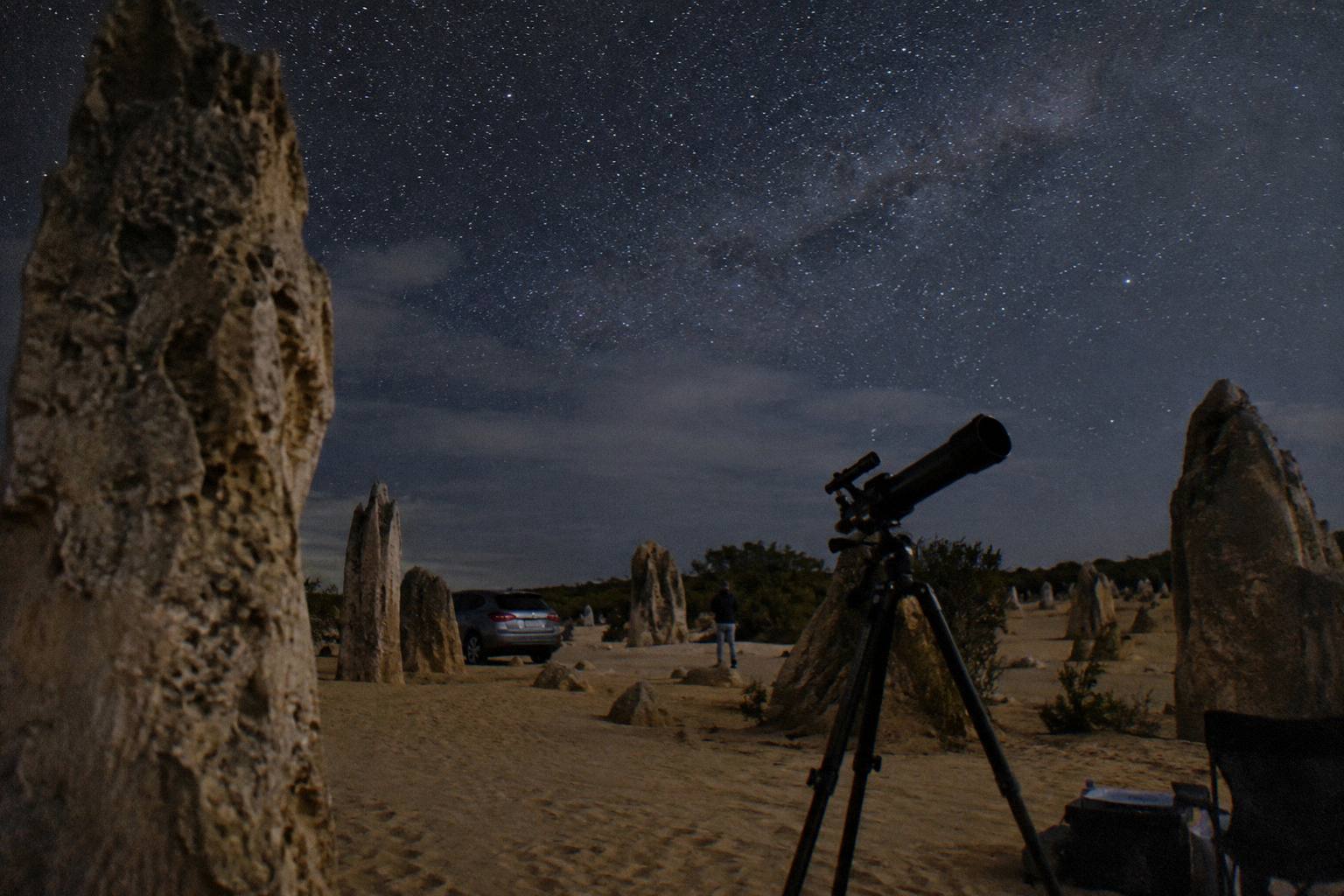
Two smaller points round it out. Park entry for private vehicles is AU$17 per vehicle in 2026 per the DBCA fee table, and a commercial tour passenger fee of AU$8 applies per passenger, though whether a given tour price includes entry is stated only where that product's own listing says so. And mobile coverage is patchy in parts of the park, so download offline maps before you leave Cervantes if you are self-driving. Whatever the sky delivers, the pillars at night are worth the planning, and Pinnacles Desert Tours keeps the lineup of guided departures in one place.
For a different angle on timing, the question of whether a full moon ruins stargazing goes deeper on lunar arithmetic than this page does. The three departures below cover the main formats for a Milky Way-oriented night.
Common Questions About The Milky Way At The Pinnacles
Can You See The Milky Way From The Pinnacles?
Yes, on clear, moonless nights. Astronomy club and retailer guides rate the Pinnacles sky at Bortle 1 to 2 and say the Milky Way is best near new moon, with skies typically clearest in the cooler months from about March to October. Cloud, moonlight and rain decide any individual night, so no view can be guaranteed.
When Is The Milky Way Visible At The Pinnacles?
Astronomy club guides place the typically clearest skies in the cooler months, about March to October. Within that window, nights near a new moon give the darkest sky. June and July are the wettest months at Jurien Bay, so clear nights between rain fronts are the winter pattern.
Does A Full Moon Ruin The Milky Way At The Pinnacles?
A full moon brightens the whole sky and the faint band of the Milky Way generally fades from view, though bright stars and a moonlit Pinnacles landscape remain. Nights within about a week of a new moon give the strongest odds of seeing the band.
Do You Need A Tour To See The Milky Way At The Pinnacles?
No, the park is open to visitors, but there is no camping in Nambung National Park and the drive back to Perth is about 200 km after a late night. A sunset and stargazing tour handles the drive, timing and, on most departures in the stargazing category, park entry and a meal.
Which Stargazing Tour Is Best For A Milky Way Night?
The stargazing category includes the Lumineer dinner tour from AU$220 per person with stargazing named as included, the Autopia small-group experience from AU$199 per person, the Australian Pinnacle Tours night-time departure from AU$249 per person and the Wildlife Tours Australia adventure from AU$174 per person. Pick on price, minimum age and pickup terms; all four allow free cancellation up to 24 hours before start.
Is Winter Or Summer Better For A Milky Way Night At The Pinnacles?
The cooler months, about March to October, are when astronomy club guides say skies are typically clearest, even though June and July carry the highest mean rainfall at Jurien Bay. Summer is drier but hazier, hotter, and the park notes possible extreme fire danger from December to March.